

This Advent I have been preaching through a sermon series I’ve entitled “Waiting on the Word.” (Yes, the inspiration was the British priest and poet Malcolm Guite’s compelling anthology of Advent and Christmas poems.) As most preachers know, the sermons we preach are not merely words for them, the assembled congregation in the seats or folks tuning into the live stream; sermons are also for us—for me. As a pastor I choose a text either from the lectionary or via the guidance of the Holy Spirit (or both) and let it marinate. I mine it for its context. I exegete it to get at the core message. I pray. I think. Then I put a few words on the page and bring them to the people with a key theme or two (or three!) and some takeaways for folks’ everyday lives.
What I’ve often found, however, is that God is good at surprising me in this process. Even though I know the key themes I think my sermons will convey, God often chooses to use my efforts in unexpected ways, both in the lives of the congregants and in my own heart and mind.
This is what happened to me this Advent. As I reminded the congregation of our need to wait on the Word, God reminded me about how varied and how gracious his communication to his people is.

A Bush, a Donkey, a Whisper
Throughout history, God’s people have esteemed Scripture as one of God’s clearest means of communication. I have heard folks describe the Bible as a love letter from God that spans centuries and multiple languages. I think this is true. Love is at the heart of God’s communication. Great kings do not have to deign to speak to peasants. The fact that the King of Kings does—over and over in myriad ways—is itself an act of grace and love that is hard to fathom.
God communicates his love to us in many forms. The Bible is full of examples of God’s willingness to speak to his people in modes that fit their unique contexts and specific needs. When Adam and Eve are naked and ashamed after the Fall, God speaks to them offering not just a list of consequences, but a promise that hope would come (Genesis 3:15). Then he tangibly communicates his love through the gift of clothing (Genesis 21). When Moses is alone in the desert God speaks through a burning bush (Exodus 3). When Moses is later leading a multitude in the desert, God speaks through tangible signs and a clear voice on Mount Sinai (Exodus 19). When Balaam sets out to curse God’s people, God speaks through a donkey (Numbers 22). God speaks to Joshua (Joshua 5), Gideon (Judges 6), and Mary (Luke 1) through heavenly messengers. God speaks to young Samuel through a voice in the night (I Samuel 3) and the exhausted prophet Elijah through a whisper (I Kings 19). Throughout the Old Testament and in the first chapter of Acts God spoke through the practice of casting lots (Proverbs 16:33; Acts 1). And, of course, God speaks most directly through Jesus Christ, the Word made flesh (John 1:14; Hebrew 1:2).
Given the range of these examples, it should have come as no surprise to me that God might speak to me this Advent not only through the texts I preached and the prayers I prayed, but also through something I hadn’t anticipated—the color purple.
The Uses of Purple
Purple is the color of Advent. If you are not from a liturgical church tradition this might take you by surprise. Aren’t red and green the colors of Christmas? Yes and no. Culturally, red and green mark the season along with silver and gold. But in the church, colors work along a different spectrum. For the church, purple is the liturgical color of penance. That’s why within much of the global church purple is the primary liturgical color of both Lent and Advent, the two most significant seasons of repentance and preparation in the church year.
If this is all foreign to you, don’t worry, you’re not alone. I’m an Advent latecomer too. For much of my life I didn’t really understand the significance of the season of Advent. Advent’s nuanced meaning and its resonance with the full range of human experience was lost on me. In practice, Advent functioned for me as “Christmas Lite” or as a mere excuse for selling us calendars to count down the days until we could open gifts. (The Lego Advent calendars are pretty cool.) For me, Advent was the beginning of Christmas festivities, not the beginning of the Church calendar. Advent was just one of many churchy words without real meaning.
Imagine my surprise when I started to discover the deeper meaning of this season. As I began to learn that Advent is not only about the first coming of Jesus roughly 2,000 years ago in a humble Bethlehem manger, but is also—just as much if not more—about the Church’s anticipation of the second coming of Christ in power and glory, the season of Advent opened up for me in a powerful way. I dove into the Episcopal priest Fleming Rutledge’s book on Advent and her assertion that “Of all the seasons of the church year, Advent most closely mirrors the daily lives of Christians and of the church, asks the most important ethical questions, present the most accurate picture of the human condition, and above all, orients us to the future of the God who will come again” (Rutledge, 1). Advent is the gritty-yet-hopeful season the folks in my town and church need. It’s the season I need too.
Advent, with its purple hue, calls us to repentance and asks us to prepare ourselves to embrace the cosmic implications of both the incarnation of Christ and the future consummation of his kingdom. Purple—with its twin ties to repentance and royalty—is a fitting color for both realities.
Purple, as it turns out, is also a fitting color for possession.
Properties of Purple
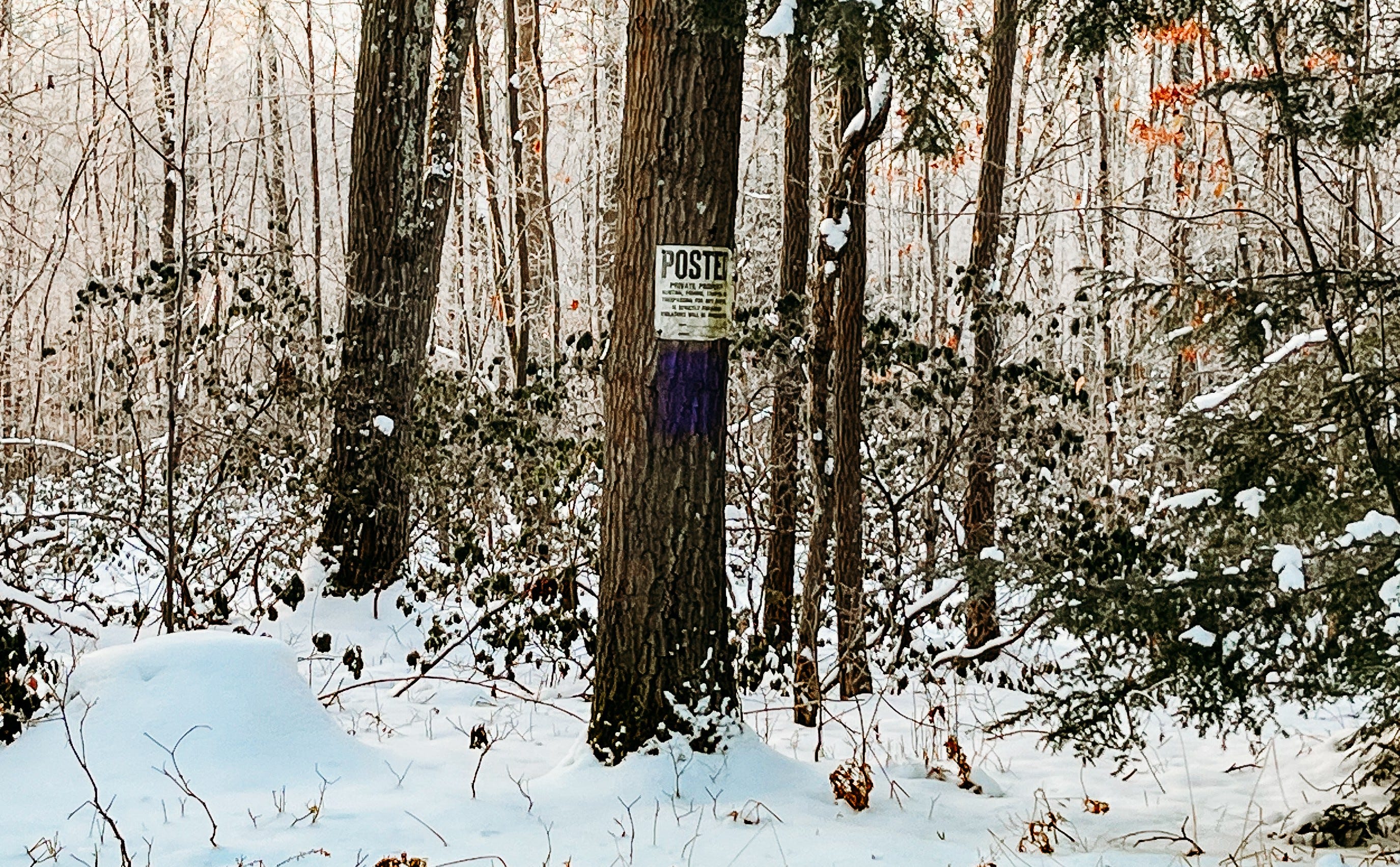
Across the corner of Penn’s Woods that I call home, purple is known as the color of possession more than it is known as the color of Advent. In 2020, the Commonwealth of Pennsylvania made a change in Title 18 of the state Crimes Code that came to be known as the “Purple Paint Law.” According to the Commonwealth, this law “gives landowners the option of using purple paint, rather than signs, to post their properties and alert others that lands are private and trespassing isn’t permitted.” (As a sidenote, I can’t help but wonder how the color purple was chosen. Perhaps there was a purple paint lobbyist in Harrisburg that week or maybe a few lawmakers simply asked, “What would be the last color a rural Pennsylvanian would naturally paint his or her trees?...Purple?...That’s it!”)
While most rural residents I know are seldom quick to change or ready to applaud a government innovation, the uptake on this practice of painting large swaths of purple on boundary trees seems to have been adopted with an unusual degree of exuberance. In the months following the law’s passage, even the fiercest localists and most government-intrusion-adverse folks I know grabbed a can of paint and a brush. While the world was worried about COVID, Pennsylvania landowners were happily social distanced in the woods with cans of purple paint.
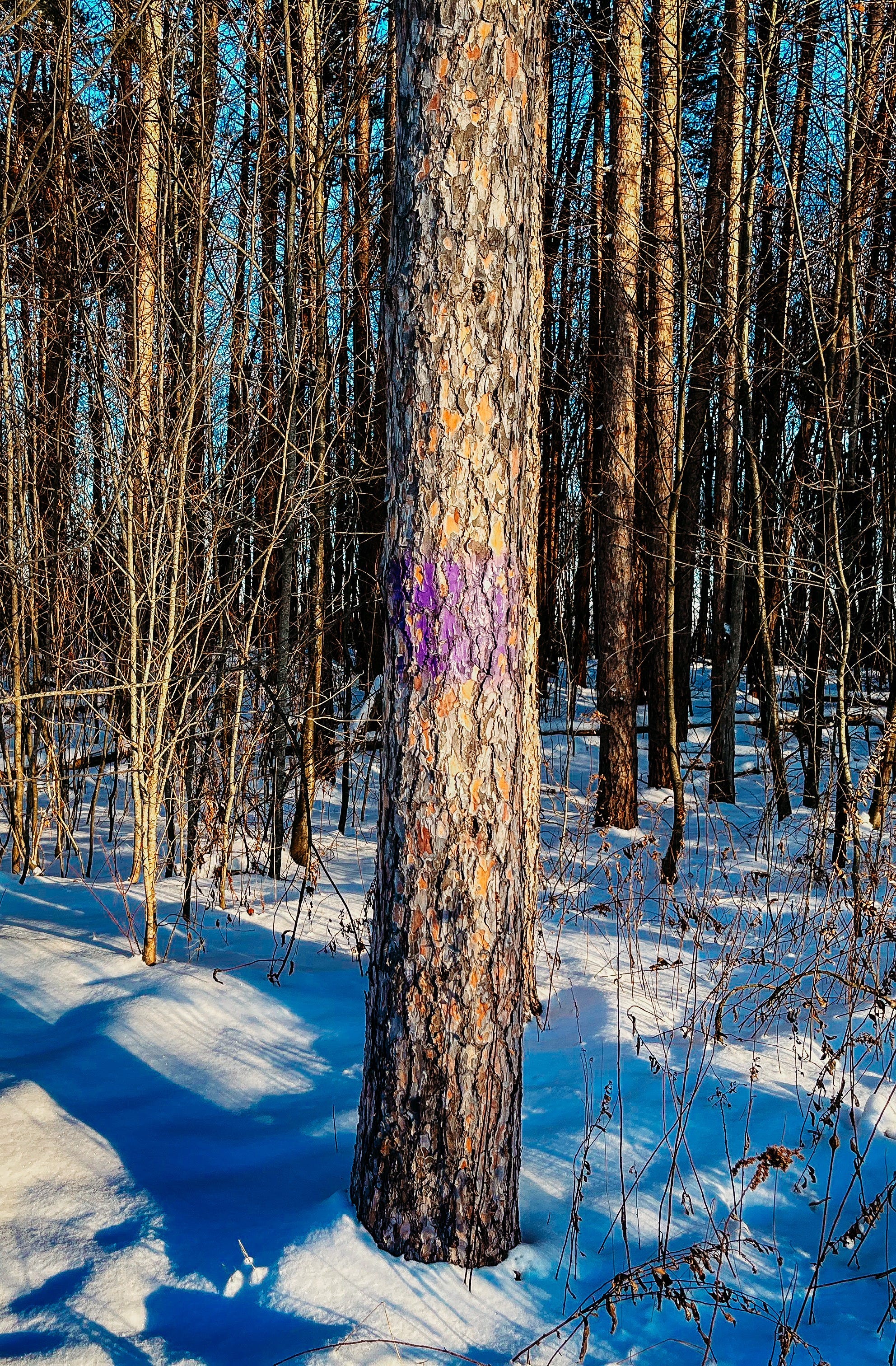
That’s how purple became the color of possession in rural Pennsylvania. Purple rectangles now mark the trees that bound the edges of our farms and roadways. This means that the color purple is now a daily part of most rural Pennsylvanian’s experience, though, like any common thing, it is easy to get so used to the jarring contrast of man-made pigment on oak and pine trunks that we no longer take notice.
Because I have a fifty-minute commute over a heavily wooded stretch of road from Oil City to Grove City, I see purple most days as I drive the ridgeline above Sandy Creek and through the Allegheny River Valley near Kennerdell. It was during these drives this Advent that God started speaking to me about the incarnation through the color purple.
Purple and the Incarnation
It should go without saying that the incarnation is the cornerstone of the Christian faith. As I remind folks in the church I pastor, we can’t separate the word incarnation from the idea of meat. A carnivore eats meat. Chili con carne in Spanish is chili with meat. The incarnation is God putting on flesh—or, perhaps more memorably, putting on meat. When the second person of the Trinity is conceived by the Holy Spirit and born of the Virgin Mary, God does something new and unique in history. Transcendence takes up immanence. Omnipresence limits itself to locality. Jesus is fully God, but he is also fully man. It is mind boggling. And, as my friend Garrett and I discussed on The Rural Ministry Podcast this week, what’s perhaps most amazing about the incarnation is that once the Son takes on flesh, he never sheds it. (The church has always emphasized the bodily resurrection and the bodily ascension of Jesus for a reason.) Jesus Christ is still embodied while he is seated and interceding for us at the right hand of the Father right now. In a sense, his intercession for us is both physical and spiritual. God the Father can’t forget about us because God the Son still looks like us.
While there’s much more that could be said about what the incarnation is, what I want to focus on in the last few paragraphs is what God has been using purple—both the purple of Advent and the purple on Pennsylvanian trees—to remind me about the goodness of the incarnation.
Advent and a New Way to Be Human
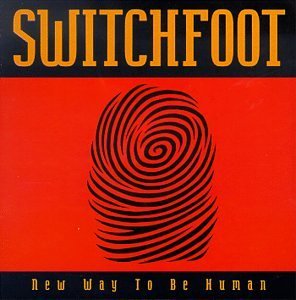
As a teen who came to faith and came of age right around Y2K, I was long enamored with the band Switchfoot. I remember listening to their 1999 album “A New Way to Be Human” over and over as a freshly licensed driver or as I practiced basketball in my parents' driveway. I was drawn to the music, the lyrics, and the overarching idea that there might be a new way to be human.
What I see now is that the incarnation provided what my favorite artists were pointing toward. When Jesus took on flesh and dwelt (living, working, walking, eating, etc.) among us, his every action demonstrated a new—or we might say, a true—way to be human. There is an ideal way to be human. God himself showed us.
To look at the life of Jesus is to see humanity for once living up to its God-imagined, God-imaging potential. It is to see the vastness of God stoop low to love a place long enough and well enough to learn a trade, to know its stories, to face its fears.
That is what Jesus did as a child, as a carpenter, as a rabbi, as a wandering story-teller, as a healer, and as a dinner guest with sinners. And he did it all without possessing much more than the clothes on his back. We humans are just stewards of God’s world, but we accumulate like we are out to own as much as we can. Jesus truly owned it all and yet he never sought to lay claim even to a place to consistently lay his head (Matthew 8:20). Jesus lived in a small place, but he lived with a big vision. Though others might see scarcity, he lived confident in the knowledge that with God there is always enough. In so doing he showed us a new way to be human, not as an idea but as a fully embodied, God-oriented life.
Waiting on the Word
This Advent as I’ve spent my forty-third December surrounded by the consumeristic inertia of another Christmas shopping season, God has spoken to me in many ways, but the least expected way was through the color purple. I know the urge to consume, to accumulate, to mark the bounds of my territory. I have always been quick with a Sharpie, ready to write my initials on toys and tools and places. I don’t have purple on my trees, but I always have a symbolic can of purple paint nearby, ready to stake my claim on this or that bit of real estate, be it physical, ecclesiastical, or intellectual.
That’s why I need Advent and the incarnation. I need the One who understands the color purple in all its regality and pain. Purple is not simply the color of a candle or a blaze on a tree; it is the color of both the robe and the bruises the incarnate Son of God received when he gave his life for us on a Roman cross. When purple touched that tree it demonstrated for all time that the new way to be human was the way of sacrifice, faith, and love.
This is a reminder that the church needs no matter the season. It’s also a reminder that Advent presents with special clarity. It is only out of the purple-hued repentance of Advent that we can come to the bright white light of Christmas or the white-horsed rider who will once and for all bring redemption “far as the curse is found.”
Maranatha. Come, Lord Jesus!

This essay first appeared on Charlie's Substack, "Strip Mine Jesus"

Charles E. Cotherman is executive director of the Center for Rural Ministry and an assistant professor of Biblical and Religious Studies at Grove City College. He is also a pastor at Oil City Vineyard, a church he and his wife Aimee had the privilege of planting in 2016. He has written on rural ministry, church planting, and history for a variety of publications including Evangelicals, Modern Reformation, Front Porch Republic, and Plough. He is the author of To Think Christianly (IVP Academic) and a contributing editor of Sent to Flourish: Guide to Planting and Multiplying Churches (IVP Academic). His next book, Strip MIne Jesus: Hope for the Rural Church, Small Towns, and Overlooked Places, will be released August 2026. He lives with his wife, four children, and a spoiled cat and dog in Oil City, Pennsylvania. Charlie can be reached at charlie@ruralministry.org or on Substack.

