

With the nation’s 250th anniversary on the horizon, a lot of folks have history on their minds. This spring I made my way through David McCullough’s long (but so worth it!) biography of John Adams. Even my wife, who is not usually inclined to read history, has picked up a monograph on the historic year 1776.
To read this history is to encounter themes that have united Americans across the centuries. One of these themes is movement. From the time of the original colonies until today, the folks who came to what would become the United States have been a people on the move—first across the ocean and then across the vast expanses of forests, prairies, and deserts. Even if the pace of movement has slowed down in the last several decades, with more Americans than ever choosing or feeling economically forced to live withing fifty miles of where they were born, we are still a nation marked by a kind of aspiration for mobility.[1] The fact that cultural commentators like The Atlantic’s Yoni Applebaum bemoan recent decreases in mobility point to the high value our culture has bestowed on this America impulse.

Whatever your opinion about this American penchant to move—whether you think it leads to worrisome transience or “just may be America’s greatest contribution to the world,”[2] as Applebaum suggests—what’s certain is that movement is a part of the fabric of our nation and our local communities that we can’t avoid.
The Direction of Movement
What’s interesting about this movement is how much of it was, at least in those early centuries, directed not toward cities but toward rural expanses and small towns. There simply weren’t many large cities in colonial America (Philadelphia was the largest in 1776 with a population of about 30,000), and many seemed to prefer room to stretch their legs and their farms. Laura Ingalls Wilder’s Little House stories about her family’s quest to find more open country on the frontier provides one especially well-known example. The Oklahoma land rush and the impulse that led family after family to load their lives into a covered wagon to venture along the Oregon Trail also showcase the wide appeal of this itch to move on and spread out.
Prior to the industrialization that roared into full gear in the late nineteenth and early twentieth century, much of the movement during the colonial period and the nation’s first century had a significant centrifugal and rural dimension. This reality shifted in the late nineteenth century, however, and the pendulum never swung back. Factories were at their most efficient when the labor pool was large and housed nearby. By the 1920 census the United States was a majority urban country. We still are. One hundred years later, the 2020 census demonstrated that between 46-66 million people called rural America home. Depending on how one crunched the numbers, however, these rural folks made up only 14-20 percent of the nation.[3]
Brain Drain, Youth Drain, and the Places Left Behind
For decades now, sociologists and demographers have been noting the outmigration—especially of young, educated people—from rural areas. The decade between 2010 and 2020 was especially noteworthy. During that time the net population of rural America decreased by .6 percent while the population in urban America grew by 8 percent.[4] Sure, some rural areas may have seen gains in population during COVID as people opted out of crammed cubicles and cities, but, as most of us who live in rural areas realize, these remote workers did not just move anywhere. Most of them didn’t move to the middle of Nebraska or to small towns in the rust belt; rather, they often moved to places known for outdoor amenities or rural places with proximity to affluent towns or regional cities. Some of these “Zoom Towns” may have experienced a local surge in population. Indeed, as sociologists like Tim Slack and Shannon Monnat note, some rural communities have grown enough that they can no longer be described as rural.[5]
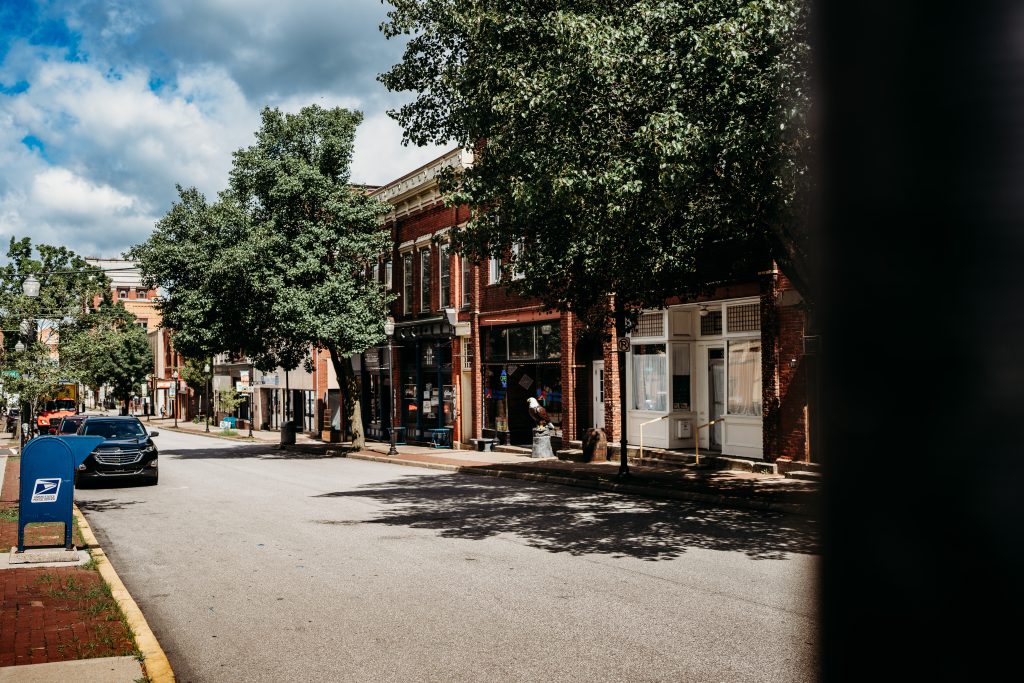
But in many regions of the country, this kind of rural growth is an outlier. In many small communities without well-known natural amenities, reliable internet service, or proximity to larger metro areas the feeling on the ground is that remote work has done little to stem the tide of outmigration, and the brain drain and youth drain feel as real as ever. If you are from a community like this, you recognize the seeming inevitability of watching many of your town’s best and brightest choose to move away without looking back and you likely sense how difficult it is to attract new folks to your small community.
There are reasons for trends like this. Some of them are self-inflicted, while others seem too large to change or challenge.
Educating For Emigration
In their 2009 book Hallowing Out the Middle: Rural Brain Drain and What It Means for America, Patrick Carr and Maria Kefalas describe how small towns often “play an unwitting part in their own decline” by lavishing attention on the brightest students while simultaneously sending them the message that success is to be found somewhere outside of their small community.[6]
It’s not just high school teachers who are sending messages like this. As Jeffrey Bilbro and Jack Baker point out in their book Wendell Berry and Higher Education: Cultivating Virtues of Place, colleges and universities seem happy to take up the same story line, as they educate young people for transience and upward mobility. Drawing on the work of Wendell Berry and an array of others, Bilbro and Baker argue for education that helps students learn to value and desire to serve the communities that they call home. This entails helping students think beyond the standard “go big or go home” narrative arc. As Bilbro and Baker note, “An education for health, one that inspires students to serve their homes, has to begin by reforming students’ imaginations so that they ask better questions.”[7]
I agree with Bilbro and Baker, but I think the need for a reformation of imagination goes further than the college classroom. We also need something like this in the rural church.
The Church and Rural Brain Drain
Can churches in rural areas play a role in stemming the flow of outmigration and youth brain drain?
It's probably safe to say that this is not a question many folks are asking at the moment. As much as many of us in rural areas might want to do something to retain our own young people and recruit others to be part of our communities, these trends may seem outside the purview of the local church. Churches preach the Gospel. Churches baptize. Churches serve the poor. Churches don’t worry about where folks live or larger demographic shifts.
This may be true to a point, but I think Scripture shows that God cares about every dimension of our lives just as God cares about all corners of the creation itself—a creation he originally described as “very good,” and a creation he hasn’t given up on. If God cares about both the flourishing of people and places, maybe the church should give more thought to both as well.
Maybe the church can play a part in stemming the tide of out migration. Maybe the church can offer a counternarrative—a new way of imagining—what it means to flourish in small places.
At the very least, I think a church can play a role in helping a young person decide to stay in or move to a small town by being part of what I have long thought of as the rural stability triangle.
The Stability Triangle in Rural America
When my wife and I moved back to the rural region we had always thought of as home in the summer of 2016, I devoted a good bit of thought to what made young people stay in or move to our area. What I eventually discovered—both from my own experience and the experience of others—was that a few things were essential for many of those weighing up the decision to move to a smaller area. Typically, people moved to our area for one of three reasons: longstanding connections with family and friends, a specific job, or local amenities (cheaper housing, a beautiful river valley, etc.).
What I began to notice was that in a small community like mine very few people were able to hold all three of these together. Maybe they had family in the area and enjoyed the bike trails, but they were working out of their field or working for far less than they could somewhere else. In other cases, maybe folks moved here or chose to stay even though they swore they wouldn’t because they had family and a decent job.
What I saw time and time again, was that it was rare for folks to make it over the long haul in small communities like Oil City if only one of these three traits was strong. If folks only moved back for family and friends, they sometimes struggled to find meaningful work and eventually either left or grew jaded. If folks moved to the area for work alone, work wasn’t usually enough to keep them here if they didn’t develop community. The same seemed to hold true for those who moved here for cheap housing or the natural amenities. If these folks were going to choose to stay for the long haul, they needed the encouragement that came from strength in at least one of the other categories within the stability triangle.
Christians and the Stability Triangle
Here’s something else I learned: for Christians—especially for Christian young people who were still trying to build families and community—a vibrant local church was another node that could be added to the stability triangle. If a young person or couple had a decent job or family in the area and they also came to truly love their local church and the community they found there, it seemed like the chances of them staying and flourishing in our small town went up in a noticeable way. If a Christian young person loves his or her church, and if this church is a place where they experience the truth and power of the living God and the goodness of belonging to the community of God’s family, they may still leave our small towns, but I can assure you they will not leave as easily.
This is one way that churches, simply by being a healthy expression of the people of God, can play a role in fighting the trends that seem to dominate our national story. Local churches play an important role in rooting people to place and community. Churches that serve and value their local community help others do the same, and churches that make space for congregants to build strong, interconnected community help strengthen the fabric of the larger community.
People still need jobs, and churches can’t do it all. But churches can do something. They can play a notable part in rooting us in community and enlarging our imagination for what is possible in the same small towns and rural areas that our culture tells us to leave behind.
Becky’s Story and My Own
Let me end with a specific example that I recently encountered in the story of one of my former students.
Becky Montoro graduated from Grove City College in the spring of 2024. During her time at college she spent a summer working as a Center for Rural Ministry (CRM) intern at Living Faith Church, a small, rural congregation about forty minutes from Grove City. (By the way, you can watch a film about her time there below.)
Becky’s summer at Living Faith was so formative that she decided to continue attending the church as part of the CRM’s Plowshare program during her senior year of college. The church embraced her as a person and as a leader. She flourished.
After graduation, Becky moved back home to south central Pennsylvania, but her heart was still with the folks at Living Faith. She wanted to return, but she knew she would need a job. When a position opened up near the church at an organization that serves women dealing with unplanned and difficult pregnancies she jumped at it even though her hometown was over three hours away. With the job and her church, Becky had two of the three aspects of the stability triangle covered. This was enough to draw her back. She decided to follow what she sensed was the Lord’s leading and move to small-town America. And, as our recent podcast interview with her makes clear, she has not only chosen to stay in small-town America; she is flourishing there.
[1] Tim Slack and Shannon M. Monnat, Rural and Small-Town America: Context, Composition, and Complexities (Oakland, CA: University of California Press, 2024), 139-140.
[2] Yoni Appelbaum, “Stuck in Place,” The Atlantic, March 2025, 34.
[3] Slack and Monnat, Rural and Small-Town America, 1-2.
[4] Slack and Monnat, Rural and Small-Town America, 25.
[5] Slack and Monnat, Rural and Small-Town America, 34.
[6] Patrick J. Carr and Maria J. Kefalas, Hollowing Out the Middle: The Rural Brain Drain and What It Means for America (Boston: Beacon Press, 2009), 24-25.
[7] Jeffrey Bilbro and Jack Baker, Wendell Berry and Higher Education: Cultivating Virtues of Place (Lexington, KY: University of Kentucky Press, 2017), 8.

Charles E. Cotherman is executive director of the Center for Rural Ministry and an assistant professor of Biblical and Religious Studies at Grove City College. He is also a pastor at Oil City Vineyard, a church he and his wife Aimee had the privilege of planting in 2016. He has written on rural ministry, church planting, and history for a variety of publications including Evangelicals, Modern Reformation, Front Porch Republic, and Plough. He is the author of To Think Christianly (IVP Academic) and a contributing editor of Sent to Flourish: Guide to Planting and Multiplying Churches (IVP Academic). His next book, Strip MIne Jesus: Hope for the Rural Church, Small Towns, and Overlooked Places, will be released August 2026. He lives with his wife, four children, and a spoiled cat and dog in Oil City, Pennsylvania. Charlie can be reached at charlie@ruralministry.org or on Substack.

