

This week I had the (mostly) pleasurable experience of going school shopping with my kids. The pleasurable part of the experience was being with my family for a day and experiencing the genuine gratitude and enjoyment of my kids as they picked out clothes for the new school year. (Don’t get me wrong. They, like me, aren’t perfect. In a day of shopping, we all had our moments.)
The pleasure of being with my family was offset by the experience of walking through store after store that was using any means possible to promote its wears to my children. (We’ve all seen this, but it seems more nefarious when one is shopping with one’s kids.) My teen and preteen kids have no sense of the historical arch of the fashions and styles they were being sold. They just knew the clothes on the models and walls were “low key cool” (iykyk).
My wife and I, however, saw the late nineties and early two thousands circling back. (If only I had kept those cargo shorts…) We were shopping with a couple of our college-aged nieces, too, so they were keeping us apprised on even more rapid style shifts, warning my teen-aged daughter that the one tote bag she planned to purchase (the one that seemed so trendy last year) was no longer the coolest of the tote bags. The same was true for water bottles and who knows what else.
Points of Stability in a World of Motion
And it’s not just our styles that change fast. It’s nothing new to say that the general movement of life comes at us with breakneck speed, not just through our phones and feeds but under our feet. Even as I write this, I’m flying along at several hundred miles an hour on a flight from Pittsburgh to Seattle. When I get there, I’ll join a group of folks serving in the Brookings/AEI Commission on US Rural Prosperity. If this trip is like the others I’ve been on, the next several days will be filled with meetings, site visits, and amazing conversations. It will be great, and all of it will be at a brisk pace. We’ll be on the move. It’s the posture of modern life, and it can feel like success.
But I’m not convinced. All this movement—the busy schedules, the full calendars and itineraries, the whatever it is that pulls you along like a planet in orbit—can feel like success. (Just listen to us all responding to the question “How’s life” with the one-word answer—“Busy.”) But is it really?
As I think about it from 30,000 feet, it seems to me that success is more in the landing, the groundedness, than the movement. To paraphrase a sign in the kitchen of one retired pilot I know, the greatest thrill known to man isn’t flying; it’s landing.
So, in all our motion, the question is where are we grounded? It’s less “Where can we go?” than “Where can we stay?”
In my new book Strip Mine Jesus, I devote a chapter to both the beauty of community and the goodness of stability. I won’t rehash those arguments or stories here. What I’ll do instead is put some flesh on what stability has meant for me this week, and why, in a world of motion, stability can help us remember what really matters and who we truly are.
Horsethief Saints
Because my family was on vacation last week, we did not have to lead services this past Sunday at the church my wife and I pastor. Instead, we worshipped with my wife’s extended family at the outdoor, multi-church worship service that has kicked off Knox, Pennsylvania’s (pop. 1,100) annual Horsethief Days Festival for several years. (Yes, you read that right. The main community festival in my hometown is Horsethief Days. I grew up there, and I still don’t fully understand the marketing calculus behind calling Knox “The Horsethief Capital of the World.”)
The joint service was, like many community services I have attended and preached at in the past, led by a blend of clergy and church volunteers, and it brought together a couple hundred folks.
What made this year’s service stand out to me wasn’t the actual content of the service as much as it was the people who took part in leading it. At two points in the service, once before the sermon and once shortly after the sermon, the ministerial association invited a member of the community to join them on the stage and share a brief message with all of us sitting in our camp chairs on Main Street.
The first person to address us was Larry Lewis. For the past fifty-six years Larry has served the town as a barber. (He’s not a bachelor, but I still like to think of him as Knox’s Jayber Crow.) Yes, he has cut a lot of hair in more than five decades of work, but he has also been a listening ear and one of the town’s primary story keepers and tellers. To walk in his shop on Main Street is to be visually taken into Knox’s story. The walls are lined with photos of local kids who have excelled in sports and music and others who have done their community proud by serving in the military. The photos span decades, and Larry knows every story.
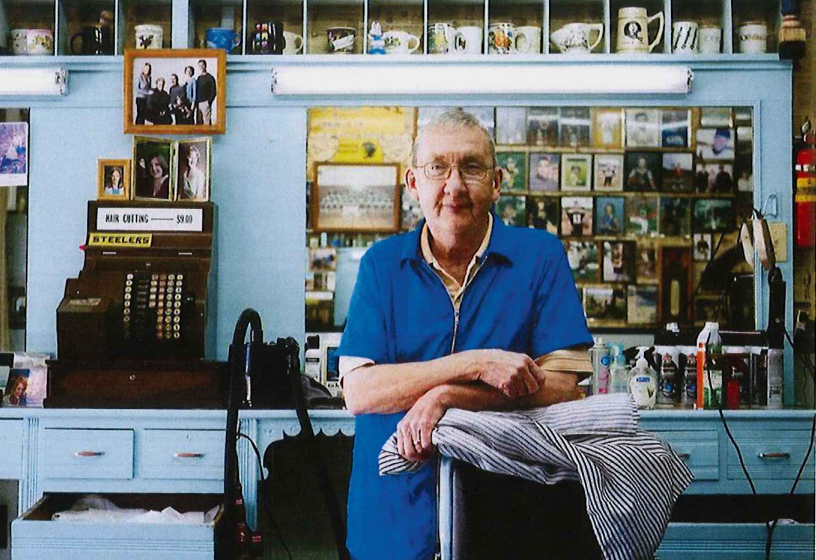
Last Sunday the roles were reversed. This time Larry told us a bit of his story, or, as he termed it, his testimony. It was a bit meandering and unpolished, but it was real, and it was his.
The town listened. A person or two even gave him a standing ovation. He was a neighbor pointing to God and offering up something for the community into which he had put down deep and extensive roots. In this case, the content and production value of his message mattered less than the content of his life.
The second lay person from the community to share this past Sunday was Esther Pries. I’ve known Esther since I first encountered her as an energetic lunch lady in the Keystone Jr. Sr. High School cafeteria. Since then, she has been a regular encourager whenever I saw her in town or when she saw something online that I had posted or done.
On Sunday the ministerial association brought Esther to the main stage to ask the community if someone might be willing to replace her as the volunteer director of the town’s food pantry. She had been in the position nearly fifteen years and, now in her eighties, thought it was time to retire. As she noted with her typical spunk, she said she was looking for five guys or one good woman to replace her.
Now it was my turn to encourage her. Her faithfulness was remarkable.
It was also rooted.
Both Larry and Esther had put down roots. They, like all of us, still lived in the frenetic world of twentieth century America. (Contrary to the stereotype, living in small-town America doesn’t drastically insolate folks from these impulses.) But they had roots. And their roots helped them serve their community in a way that mattered, a way that was personal and tangible, in a way jet-setting, or whatever perpetual movement you find yourself drawn to, will never be able to replicate.
Choosing to Love Where Our Feet Are
Most of us get to decide, at least to some extent, if we will inhabit stories like those of Larry and Esther. We don’t have to be barbers or run a food pantry. We have to look around right where we are and invest in the community we are in for as long as we are there. Sure, longevity matters, but you might be a student, a pastor, or a member of the military without total control over those things. What you and I can control is today. How will we live right where our feet are?
For me this point came home yesterday. While we were shopping, I received a text that a death had occurred within the church. I came home from school shopping and met with the family in the midst of their grief. We shared stories and planned a funeral. It was real. It was human. It was undeniable that God was with us.
Moments like this root me in a real place with real people.
When I flew out this morning, I flew out with this family in my prayers and these stories in my mind. They are part of the community that grounds me. Later this week, I’ll take a red-eye back home and preach the funeral that afternoon. Will I be tired? Yes. But I will also be grounded in real relationships.
As the pace of life speeds up for all of us, I think it is relationships within communities, relationships taken up for the long-haul when possible, that help keep us grounded in the best way. Relationships bring obligations. Relationships can make us tired. But rooted and binding relationships are good for the soul. They often act as—and perhaps are even designed by God to be—points of stability in a world in flux. This was the truth I found with a grieving family on a porch last evening and the reality embodied by two Horsethief saints last Sunday.
NOTE; This is an excerpt of an article that originally appeared on Charlie's Substack.

Charles E. Cotherman is executive director of the Center for Rural Ministry and an assistant professor of Biblical and Religious Studies at Grove City College. He is also a pastor at Oil City Vineyard, a church he and his wife Aimee had the privilege of planting in 2016. He has written on rural ministry, church planting, and history for a variety of publications including Evangelicals, Modern Reformation, Front Porch Republic, and Plough. He is the author of Strip MIne Jesus: Hope for the Rural Church, Small Towns, and Overlooked Places, To Think Christianly and a contributing editor of Sent to Flourish: Guide to Planting and Multiplying Churches. He lives with his wife, four children, and a spoiled cat and dog in Oil City, Pennsylvania.

