
This fall the Grove City College Center for Rural Ministry (CRM) will launch a new two-year affinity group for pastors who serve rural and small-town congregations across the region. While the exact day of affinity group meetings is still being determined, these meetings will take place one weekday morning every other month on the Grove City College campus. The first meeting will likely be held in early October. Registration information can be found online.
Why Join a CRM Affinity Group?
As a pastor myself, I can anticipate the response that might be rising in the mind of any pastor who made it through the first paragraph. It might go something like this: I’m already busy and feel more stretched than I would like. What would I gain from a group like this? Is it worth the investment?
These are great questions. I know I wrestle with them when I am thinking through how to best steward my time and energy. I think the answer to this question might vary. For some pastors reading this, the answer might be that now is not the time for a commitment. For others, a group like this could be exactly what you need. I know that pastoring can often be a lonely task. Pastors are surrounded by people and yet often isolated by the nature of their task as leaders and confidants. Similarly, pastors are always teaching but seldom have time to invest intentionally in their own learning and formation.
If either of these last two realities describes your experience, you may want to consider participating in our upcoming affinity group. As I lead this group, my primary focus will be on creating space for relationship and resourcing that helps you flourish not just in your calling as a pastor, but in your larger calling as a human being made in the image of God. God made us for relationship with him and with others. Affinity groups are designed to help us walk further into both callings.
What Would Happen at an Affinity Group Meeting?
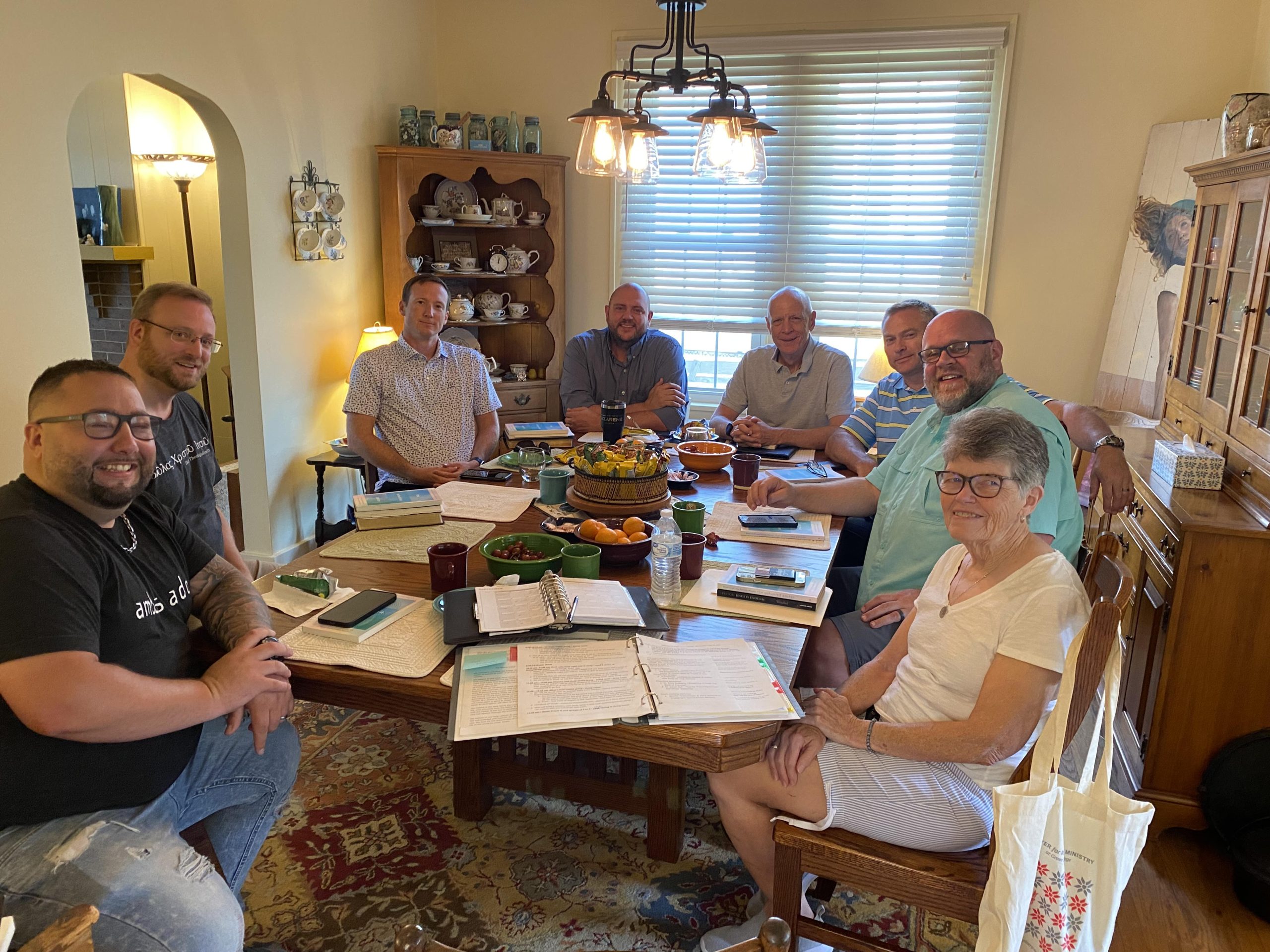
I plan to follow the pattern set by CRM Pastor-Liaison Bill Sukolsky. As a retired pastor, Sukolsky harnessed a lifetime of experience as he designed an affinity group that he launched for pastors in southwestern Pennsylvania last April. As he notes, “I have had the privilege of meeting with ten pastors as the CRM South Affinity Group. We have met formally together twice in my home since April 2024, with informal meetings between participants taking place at other times as well. The ten pastors (nine men and one woman) range in age from their early 30’s to their mid-60’s, serving congregations of different sizes and traditions in various rural communities in southwest PA.”
The pastors who gather around the table with pastor Sukolsky every other month share food, stories, and resources with each other. Participants talk through their individual stories and engage helpful books together. At most meetings, the group discusses a difficult ministry situation or case study that one of the pastors is currently facing in ministry. The feedback from the group has been great so far. I can’t wait to build on this momentum with a Grove City-based affinity group.
The Big-Picture View: Burning Bushes and Filled Reservoirs
From the start, pastor Sukolsky has been quick to point out that he thinks two images highlight the function affinity groups can place in the life of a congregational pastor:
Burning Bush Moments: With deliberate allusions to Exodus 3, we frame our three-hour gatherings as opportunities for busy shepherds to turn aside, and seek God’s living presence with others. Too often the daily grind keeps us from seeing the glory of God burning in our midst. Our gatherings have been moments to pause in our ministry, take off our shoes, and pay attention to what the Lord is saying to us as his people. We have heard and seen Him through shared hospitality, honest conversations, and prayer together. These times have begun friendships, without which none of us can thrive and survive the rigors of ministry.
Filling the Reservoir: Bernard of Clairvaux said that pastors too often erroneously think of themselves as only canals through which the presence of God flows, leaving them untouched. Instead, he said that pastors need to see themselves as reservoirs – retaining the water needed to be filled, then overflowing to others without loss to themselves. Pastoral ministry is draining in all sorts of ways, so I have described our gatherings as one of the streams to fill the reservoir of the heart. The pastors who gather take part in three practices: sharing life stories together to build friendships, reflecting on Scripture and theology to live more faithfully in our families and congregations, giving and receiving counsel about their own ministry and family struggles to increase our competencies and emotional health. The CRM south pastors have affirmed how taking part in all three practices have encouraged them as they engage in their ministries.
I know both of pastor Sukolsky' s images speak to my heart as a pastor. If you feel like you could use a burning bush moment in your ministry, or if you feel like the reservoir of ideas or friendship is lower than you like, I encourage you to consider registering for our upcoming pastor affinity group.

Charles E. Cotherman is executive director of the Center for Rural Ministry and an assistant professor of Biblical and Religious Studies at Grove City College. He is also a pastor at Oil City Vineyard, a church he and his wife Aimee had the privilege of planting in 2016. He has written on rural ministry, church planting, and history for a variety of publications including Evangelicals, Modern Reformation, Front Porch Republic, and Plough. He is the author of To Think Christianly (IVP Academic) and a contributing editor of Sent to Flourish: Guide to Planting and Multiplying Churches (IVP Academic). He lives with his wife, four children, and a spoiled cat and dog in Oil City, Pennsylvania. Charlie can be reached at charlie@ruralministry.org

Bill retired at the end of 2021, after serving two Presbyterian congregations in southwest PA for a little over 40 years. He has been married to Karen for 45 years, with three married daughters and five grandchildren. He enjoys landscaping, fishing, and shooting. In retirement Bill continues to meet with numerous people for prayer and conversation; does supply preaching in various congregations; and leads a home Bible study and engages in prison ministry on a weekly basis. His long-standing desire to support and encourage pastors has continued into retirement, and he looks forward to serving Christ in that capacity with the Center for Rural Ministry." Bill can be reached via email at bill@ruralministry.org.

