
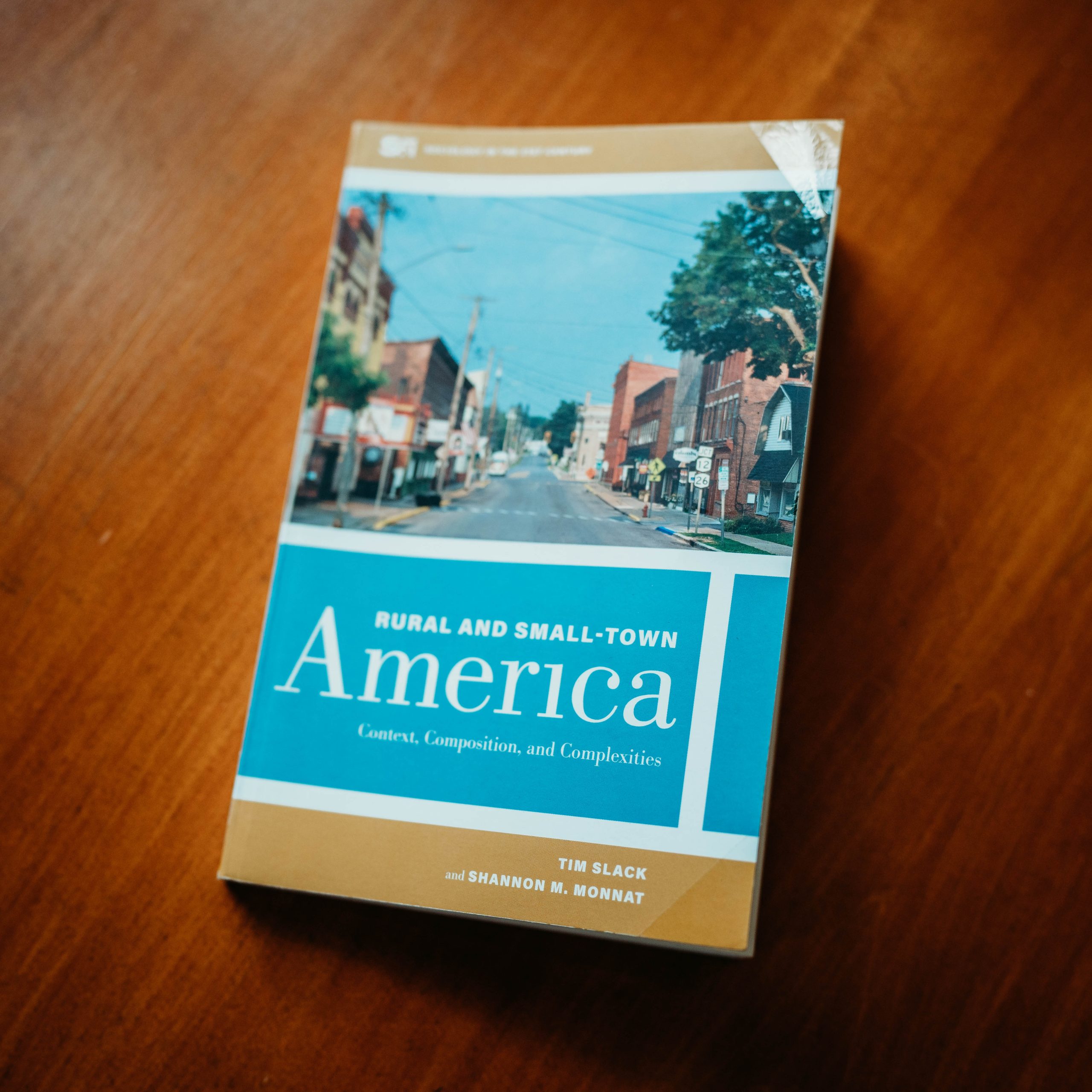
Slack, Tim and Shannon M. Monnat. Rural and Small-Town America: Context, Composition, and Complexities. Oakland, CA: University of California Press, 2024.
Who lives in rural America, and what trends, challenges, and opportunities define their lives?
If you’re like me, it can be tempting to answer questions like these with anecdotes and hunches. There is something to be said for the on-the-ground observations of folks who call rural areas home. Sometimes we get things experts don’t.
Sometimes, however, the opposite can also be true.
When we trust our instincts, we may not realize how our local experience maps onto the larger reality of rural places across America. I think this is precisely why Tim Slack and Shannon M. Monnat’s book Rural and Small-Town America is such a helpful tool for those seeking to better understand rural and small-town America and its inhabitants.
In part one of this two-part review, I followed Slack and Monnat by taking time to lay out the differences in several prominent definitions of rurality. In this section of my review, I will dig deeper into the book’s content and primary themes. As I think you’ll see, the authors' quantitative approach provides a helpful starting point for those hoping to better understand the sociology and demographics of rural America.
Rural Population Change and the Paradox of Success
It is fitting that Slack and Monnat choose to begin the body of their work with a discussion of rural population change. Depending on where a rural community is located, the idea of population change may carry different shades of meaning. In some parts of the country, like the rust belt region that I call home, the idea of rural population change usually entails a loss of population, especially a loss of a younger, more educated demographic. Of course, in other rural communities, population change feels different. Some rural communities are growing—a reality that may or may not be especially well received by long-term residents of these places
But even these seeming “winners” among rural communities haven’t been enough to steady the ship for rural America as a whole. While the authors discuss a “rural rebound” that marked rural communities in the 1990s and early 2000s, the last decade before the 2020 census provided a check against rural optimism. Trends in fertility, mortality, and migration led to the first decadal rural population loss in American history between 2010 and 2020 (25). While rural areas experienced a greater natural increase and net migration that urban areas from 2000-2010, “between 2010 and 2020, nonmetro areas saw negative net migration” which led to a population loss of .6 percent in rural areas. During the same decade, urban population grew by 8.8 percent (25).

As sobering as these statistics are, the stats alone don’t fully explain rural population change. To understand the full scope of these shifts we have to account for the rural success paradox.
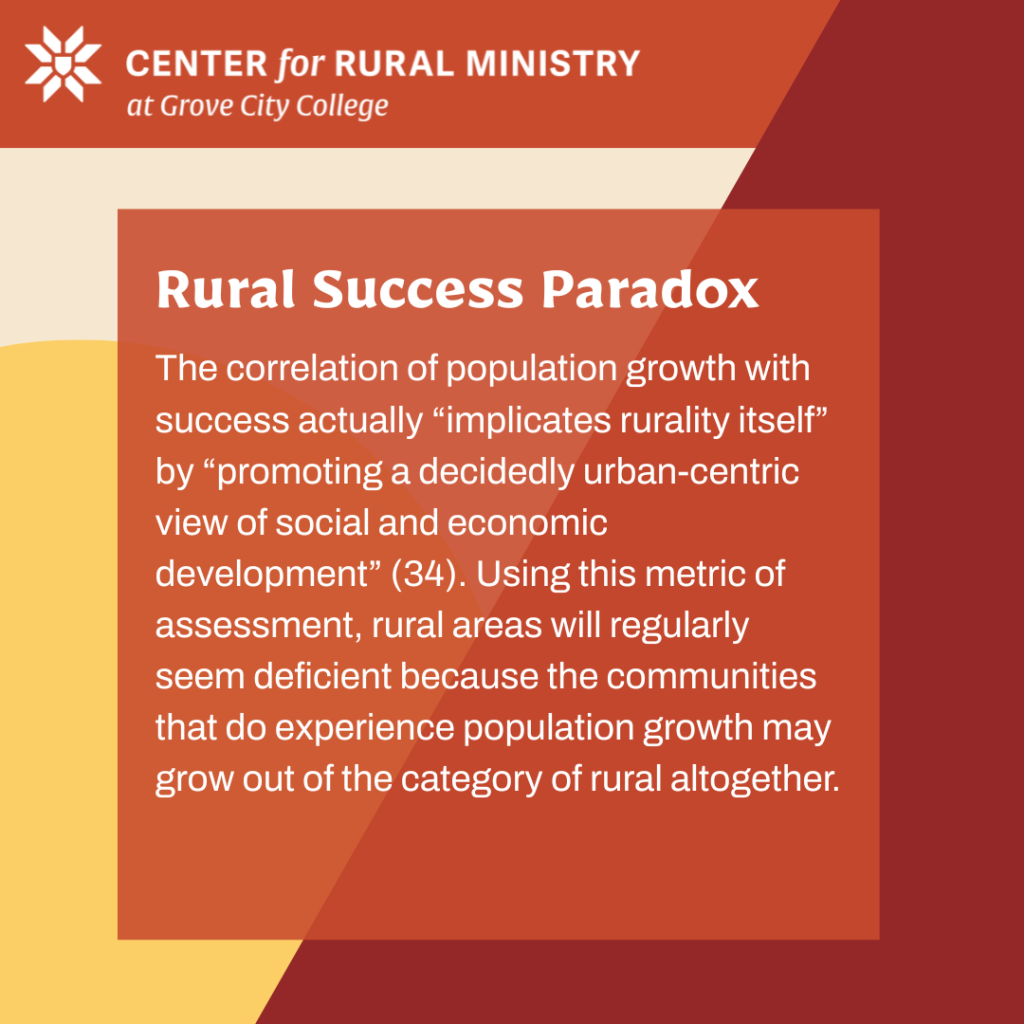
When rural areas experience success (usually understood to be an increase in in-migration) this success will, at a certain point, mean that the federal agencies no longer classify these growing communities as rural. As Slack and Monnat note, the correlation of population growth with success (and the corresponding understanding that “the absence of sustained population growth is a social problem”) actually “implicates rurality itself” by “promoting a decidedly urban-centric view of social and economic development” (34). Using this metric of assessment, rural areas will regularly seem deficient because the communities that do experience population growth may grow out of the category of rural altogether.
Rural Livelihoods and Diversity
Slack and Monnat follow up their chapter on rural population trends with a chapters on rural livelihoods and diversity in rural America.
When it comes to labor trends in rural America, the key shift involves a drastic decline in farming and industry and the notable growth in service sector jobs. This shift likely cuts against the Wendell Berry-inspired imagination of some who think of rural America as a bucolic land of family farms and agriculture. The decline in American farming was steady throughout the twentieth century from 1900, when just under forty percent of Americans were employed in agriculture, to 2000, when less than two percent worked in farming (38).
It wasn’t just farming that suffering in rural places. The range of options in a majority of communities is limited. Economic diversity—the range of possible jobs—in rural areas is far lower than that of urban areas. As Slack and Monnat note, the USDA describes 70.4 percent of nonmetro counties “as being dependent on a particular economic sector” (43). By way of comparison, the number for urban areas is 44.1 percent. This lack of job diversity can have significant implications for the long-term health of rural communities. Without job diversity, it only takes the closure of one manufacturing plant or mine to deal a devastating blow to the surrounding community.

Ironically, as job opportunities have become less diverse, the demographic diversity of rural American has grown significantly in recent decades. While “about 88 percent of nonmetro counties have a population that is over half White,” the trends are changing due to fertility rates and migration (67-70). As of 2020, “nearly one in three rural residents under age 18 was non-White” (67). Furthermore, the percentage of immigrants living in rural areas has increased steadily since 1970 (70). According to Slack and Monnat many of these individuals experience the “double jeopardy” of being rural and minoritized (92).
Rural Healthcare and Politics
Slack and Monnat devote the final two chapters of their book to a discussion of rural healthcare and politics. For most of us who call rural communities home, both of these topics feel timely. In many rural communities, access to local healthcare options is becoming less and less predictable. As many rural residents know, it has become difficult to recruit doctors and specialized medical professionals to rural areas, even as recruiters have turned to signing bonuses and elaborate salaries and fringe benefits. Similarly, the political landscape of rural American—like the political landscape of the country in general—has been shaped by acrimonious trends in national politics.
Slack and Monnat begin their discussion of rural healthcare with the attention-grabbing sentence, “Americans are dying too young.” While this may be true for all Americans as compared with residents in peer nations, the mortality rates are especially dire in rural places. The reality that residents of rural areas experience a higher death rate than residents of urban areas is known as the “rural mortality penalty” (95).
While we may take this reality for granted today, it is helpful to remember that the opposite was long true in American history. In the late 19th century it is estimated that the urban mortality rate was 50 percent higher than the rural rate (96). Developments in urban sanitation erased this rural-urban gap by 1940, and for several decades the life expectancy of folks in rural and urban areas was largely the same. For rural men, this changed in the 1980s. For rural women, the change came in the 1990s. Since then, the mortality rates have been higher for rural residents in every major cause of death category, with the exception of homicides and drug overdoses (99). While rural counties in some regions were starting to see a reversal in these trends (107), rural health in most areas remains below national averages. As the authors note in the final pages of their chapter on healthcare, a variety of micro, meso, and macro healthcare decisions on the part of individuals, communities, and government policies impact these realities (107-113).
This discussion of policies related to rural health care provides a natural jumping off point for a wider discussion of rural politics and policies. In this chapter, Slack and Monnat provide a brief overview of how different understanding of the rural-urban divide have shaped American politics going all the way back to Thomas Jefferson and Alexander Hamilton (126-127). They pick up on political scientist Katherine Cramer’s concept of “rural consciousness,” which understands political orientation as significantly place based. Crammer suggests that rural folks share three things: a sense that rural areas are ignored by politicians and policy makers; a perception that rural areas do not get their fair share of resources; a sense that rural folks have fundamentally distinct values and lifestyles (132). Whether or not these understanding are true, this rural consciousness can exert a significant influence on how rural residents understand American politics.
While Slack and Monnat add nuance to commonly held perceptions (e.g., the idea that a “rural revolt” led to the election of Donald Trump in 2016), perhaps the most helpful aspect of this chapter on rural politics and policies is their strong advocacy for “place-based policies” as opposed to “person based policies” (139). As they note, the difference between the two approaches comes down to the question, "Is it better to invest in people’s ability to move to relocate to more prosperous places or to invest in revitalizing distressed areas where people already live” (139)?
Slack and Monnat never come decidedly down on one side of this debate or the other, but it is not hard to discern their desire for greater attention to the realities of place when it comes to discussions about policy. As they note near the end of the chapter, “policies must consider the unique needs of rural places, including how those needs vary across different regional, economic, and demographic contexts” (143).
A Good Starting Point
The topics that come under analysis in Slack and Monnat’s Rural and Small-Town America provide a helpful and relatively short (151 pages, not counting endnotes) quantitative foundation upon which one can continue to build a robust and nuanced understanding of rural America. To this reader's mind, the authors accomplished their stated goal, “to paint a social demographic portrait of rural and small-town America, with an emphasis on changes and challenges,” while notably avoiding the condescension that can often slip into books about rural people and places (6). I hope many pastors and denominational leaders read and consider the arguments and observations within these pages.

Charles E. Cotherman is executive director of the Center for Rural Ministry and an assistant professor of Biblical and Religious Studies at Grove City College. He is also a pastor at Oil City Vineyard, a church he and his wife Aimee had the privilege of planting in 2016. He has written on rural ministry, church planting, and history for a variety of publications including Evangelicals, Modern Reformation, Front Porch Republic, and Plough. He is the author of To Think Christianly (IVP Academic) and a contributing editor of Sent to Flourish: Guide to Planting and Multiplying Churches (IVP Academic). His next book, Strip MIne Jesus: Hope for the Rural Church, Small Towns, and Overlooked Places, will be released August 2026. He lives with his wife, four children, and a spoiled cat and dog in Oil City, Pennsylvania. Charlie can be reached at charlie@ruralministry.org or on Substack.

