

Advent is one of those churchy words that I doubt many folks actually understand or appreciate. Even for those who are somewhat familiar with the word—thanks to Advent calendars or wreaths—the season of Advent often works as either a synonym for Christmas or as a kind of warm up to the main event. (Think layup lines before the actual basketball game.)
I don’t say this out of superiority. I say this out of experience. For the first thirty years of my life, I thought about Advent in a similar way. (Or perhaps more accurately, I didn’t really think about Advent much at all.) Now as a pastor in a low church denominational tribe, I find that many folks in the church I pastor come to this season without much of a theological grid—and without the wonderful sense of expectation this season offers.
Fortunately, it doesn’t take much to help folks move from thinking of Advent as “Christmas-lite” to the discovery of Advent as a season that helps us make sense of not just Christmas, but all of life. And, as I’ll argue later, there are few places better at helping folks embrace Advent in all its real-to-life angst and joy-laden hope than the small, rural church.
The Goodness of Advent
Before we get to the rural church, we need to wrestle with two questions. What is Advent, and what does it mean for us?
In the introduction to her excellent compilation of Advent sermons, Fleming Rutledge attempts to place Advent in history. She notes that the church observed a season of penitence and fasting in December as early as the fourth century, though at first this season may have had little connection to Christmas.[1] Advent’s connection to the Christmas season seems to have begun to solidify around 567 CE, when the Council of Tours ruled that the twelve days of Christmas began on December 25 and ran through Epiphany on January 6.[2] As Rutledge notes, “by the seventh century…the Advent-Christmas connection was well established.”[3]
The fascinating thing about Advent—and the aspect of the season most neglected—is the future-oriented posture of this church season. Advent means “coming," a definition that makes sense given the word’s connection to the coming of Jesus two thousand years ago in Bethlehem. Within church history, however, Advent has always been about more than simply remembering the incarnation as a historical reality. There has always been an eschatological note in Advent observances. The coming we anticipate in this season is not just the first coming of Christ, it is also his anticipated return, his second-coming when he will set all wrongs right. In short, Advent is about Revelation 21-22 just as much as it is about Luke 1-2.

This emphasis on not one but two comings of Christ matters. It helps us look squarely at the world as it is without detached fatalism or self-deceptive escapism. Advent faces the complexities of a world full of both glorious God-breathed potential and the brokenness of sin, death, and despair that hammers away at us like storm-driven waves. To quote Rutledge once more, “Of all the seasons of the year, Advent most closely mirrors the daily lives of Christians and of the church, asks the most important ethical questions, presents the most accurate picture of the human condition, and above all, orients us to the future of the God who will come again.”[4] In so doing, the season of Advent helps us face squarely the realities of a broken world while also differing from other church season in its ability to point “beyond history.” (6).
Advent and the Kingdom of God
This emphasis on the significance of both Advent events fits well with the emphasis in recent biblical scholarship on the two-stage coming of the kingdom of God. This framework, popularized by Fuller Theological Seminary professor George Eldon Ladd in the mid-twentieth and then adopted by a majority of biblical scholars and theologians, describes the inbreaking the kingdom of God as coming in two stages. The kingdom of God was inaugurated by the first coming of Christ (which includes his sinless life, death on the cross, and resurrection) but it is yet to be fully consummated. This reality explains the church’s prayer: “Your kingdom come, Your will be done, on earth as it is in heaven” (Matthew 6:10).
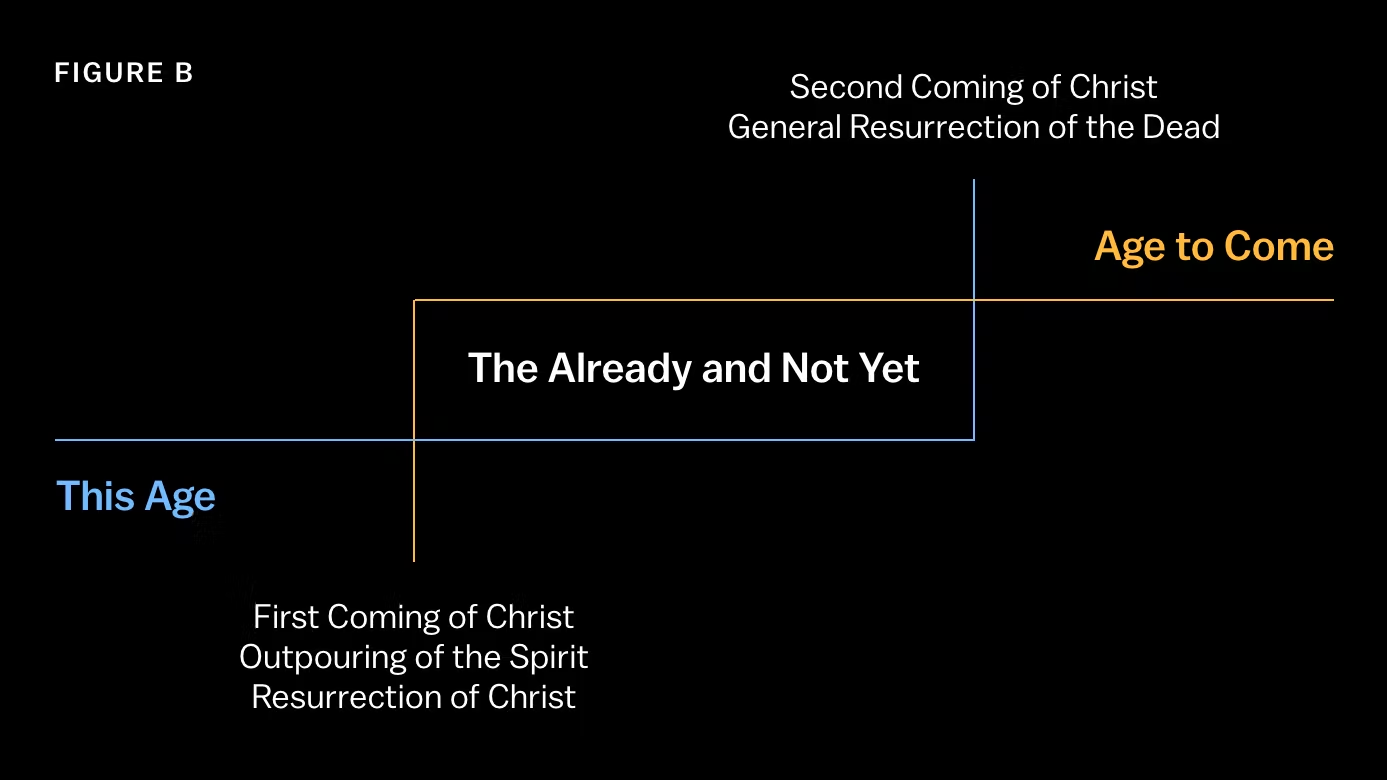
For those of us who live between these two Advents in “the time between the times” or the “already and not yet” reality of the Kingdom of God (see diagram above), the tension between both realities can been difficult to navigate. In Christ’s finished work on the cross, the decisive battle has been won and the final victory is assured. But the struggle between good and evil is still playing out. There are still life-and-death struggles. There are still casualties. We look toward the day when “the wolf shall dwell with the lamb and the leopard shall lie town with the young goat” (Isaiah 11:6, ESV), when God will “wipe away every tear from their eyes, and death shall be no more” (Revelation 21:4a), but that day has not yet come.
This is the Advent—the return of our King—we are waiting for. This is the Advent we pray for with the church historic. Maranatha—Come, Lord Jesus.
Advent and the Rural Church
While Advent is the heritage of all Christians, and no group holds an exclusive claim on this powerful season of watching and waiting, I think it is possible to make a case that rural churches—and perhaps small, human-scaled churches everywhere—understand the season of Advent with a depth of knowledge born out of the realities of small-church life. Small churches function on a scale that makes it possible for most people in the church to know most other members of the congregation. Of course, this can carry unwanted consequences. (The stereotype of the nosey church mouse is probably a stereotype for a reason.) However, the more significant reality that stems from these relationships is the integration of life and the in-it-togetherness that is uniquely possible in small churches and small communities.
In these settings, folks who worship together know the other members of the congregation as fellow congregants, but they also know and interact regularly with them as teachers, dentists, plumbers, students, coaches, and Walmart cashiers, as moms, dads, sons, uncles, and in-laws. When the team wins the championship, we all feel it. When a company moves out, a battle to cancer is lost, or a family loses a child to suicide or overdose, we all feel it too.
What this means is that every time the small church meets, the widely divergent realities each person and each family is currently experiencing are foregrounded in a way that would be impossible in a larger church.
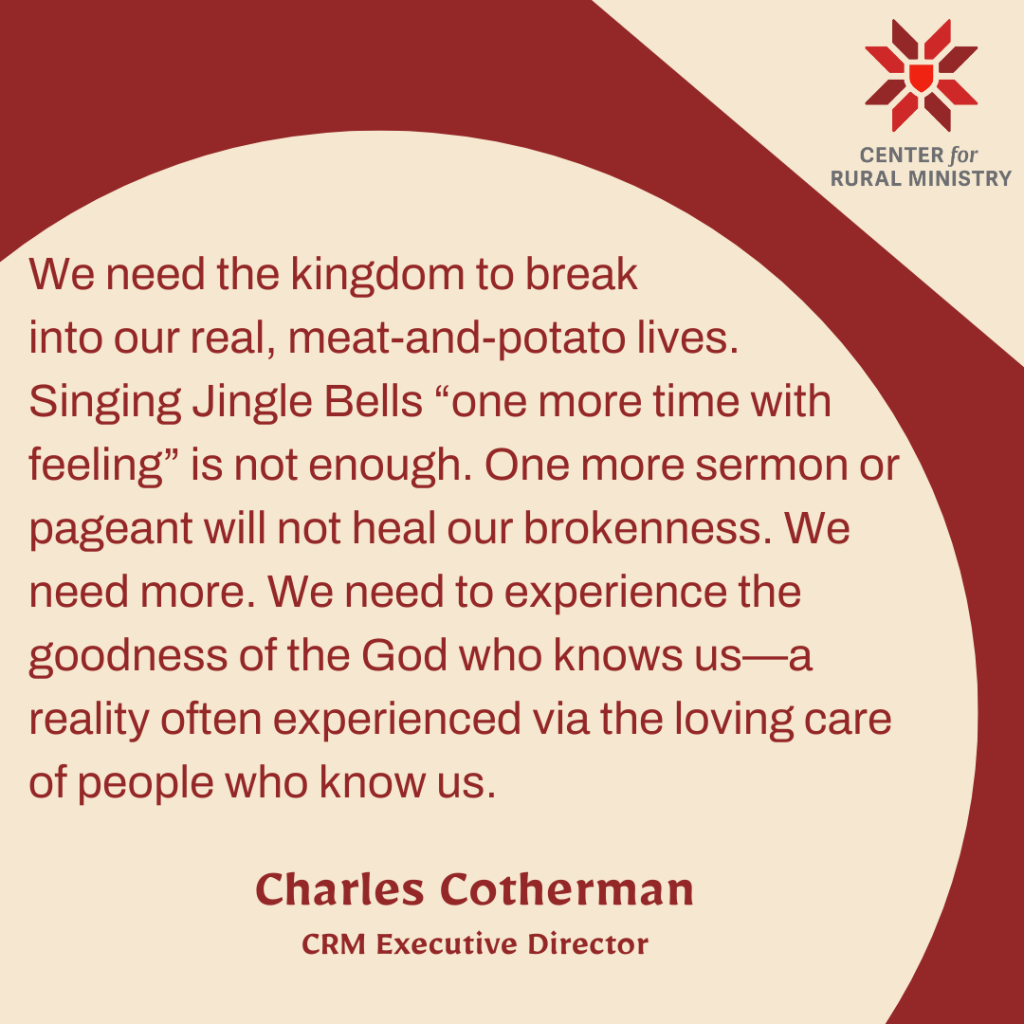
While a large church may be able to create exquisitely produced worship experiences that convey the goodness of the Gospel with energy and technical skill small churches could never muster, what is lost in the glitz and sheer size of a larger church is the reality Advent points toward. We need the kingdom to break into our real, meat-and-potato lives. Singing Jingle Bells "one more time with feeling" is not enough. One more sermon or pageant will not heal our brokenness. We need more. We need to experience the goodness of the God who knows us and meets us in our everyday lives. More often than not, we experience this reality via the loving care of people who know us. In the life of the small church we can’t avoid or look away from these realities. The opportunities to “rejoice with those who rejoice and weep with those who weep” are constantly before us. Each story has a name and a face. We will encounter these stories when we get milk or get our cars inspected.
The life-on-life realities that are almost unavoidable in small churches and small towns keep us honest in the same way our annual observance of Advent does. We can't avoid knowing the pain in other people's stories. This reality draws us toward the posture of Advent. We can't truly fool ourselves. The world is not what it should be. Evil is real and active—both out there and in our own hearts. We long for things to be set right. We long for the return of the King. But we long for these things as a people with real hope. All is not lost. The manger is real, just as the cross and empty tomb are real. We are Advent people. We are people who live between the times. We will continue to weep with our neighbors who weep and to rejoice with our neighbors who rejoice until all weeping comes to an end.
Even so, come, Lord Jesus!
[1] Fleming Rutledge, Advent: The Once & Future Coming of Jesus Christ (Grand Rapids, MI: Eerdmans, 2018), 3.
[2] Emily Hunter McGowin, Christmas: The Season of Life and Light, Fullness of Time (Downers Grove, IL: Inter-Varsity Press, 2023), 19.
[3] Rutledge, Advent, 3.
[4] Rutledge, Advent, 1.
Photo credit: Alexa Marquis at Oakwood Photo + Video

Charles E. Cotherman is executive director of the Center for Rural Ministry and an assistant professor of Biblical and Religious Studies at Grove City College. He is also a pastor at Oil City Vineyard, a church he and his wife Aimee had the privilege of planting in 2016. He has written on rural ministry, church planting, and history for a variety of publications including Evangelicals, Modern Reformation, Front Porch Republic, and Plough. He is the author of To Think Christianly (IVP Academic) and a contributing editor of Sent to Flourish: Guide to Planting and Multiplying Churches (IVP Academic). He is currently working on a book on rural ministry and small-town flourishing entitled Strip Mine Jesus (Baker). He lives with his wife, four children, and a spoiled cat and dog in Oil City, Pennsylvania. Charlie can be reached at charlie@ruralministry.org

