
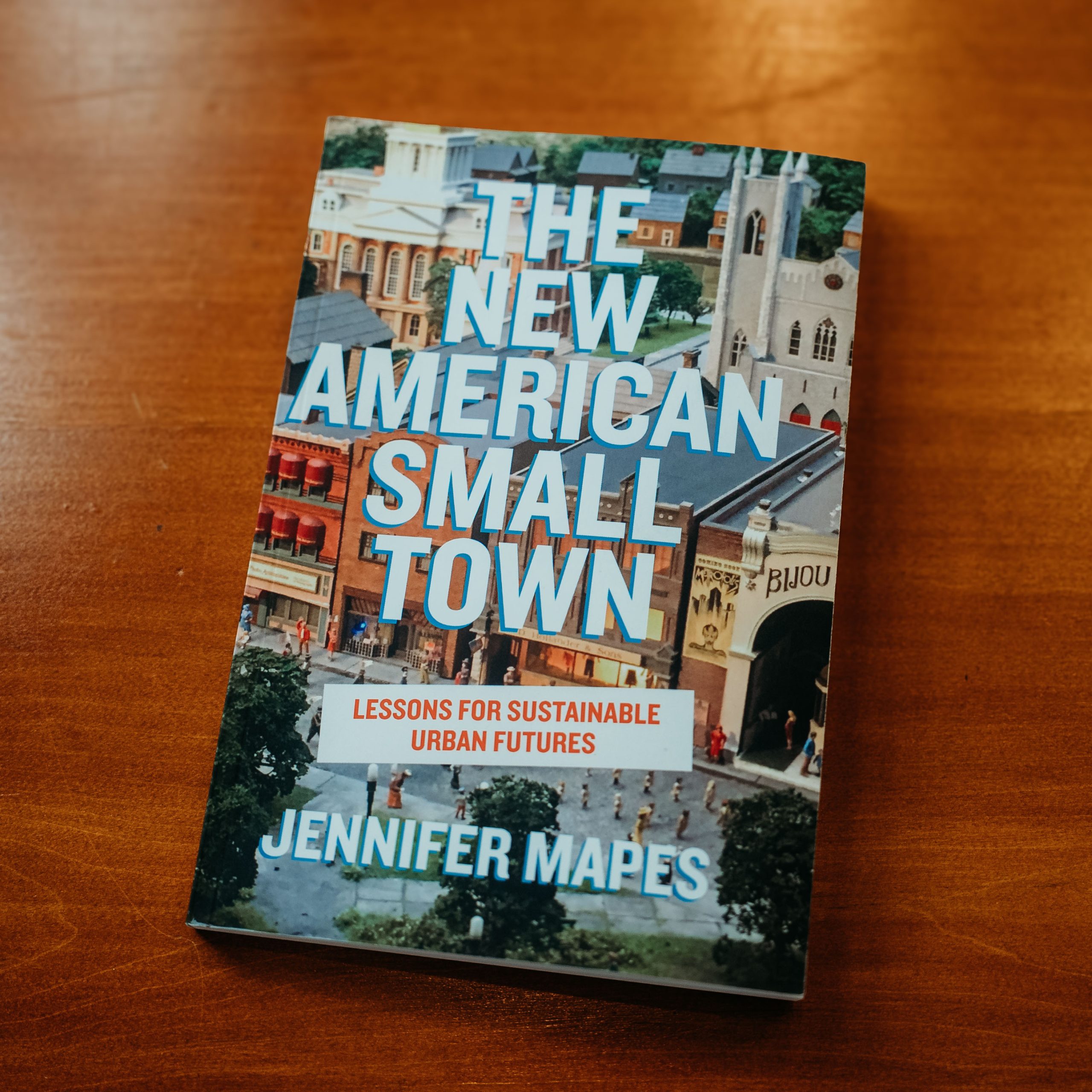
Jennifer Mapes, The New American Small Town: Lessons for Sustainable Urban Futures (West Virginia University Press, 2025)
The phrase “small-town America” brings with it a particular kind of nostalgia. A walk down the Main Street of our memories takes us past the warm glow of shop windows to a town square draped in lights for the annual Christmas parade. A walk down many Main Streets in 2025, however, is just as likely to take us past boarded-up windows and crumbling brick storefronts. Recent history has been kinder to Wallstreet than Main Street. Rural and small-town America both seem to have been left behind.
Jennifer Mapes, however, has her doubts. In her recent book The New American Small Town: Lessons for Sustainable Urban Futures, she argues that there is a lot more going on in American small towns than we might think. Mapes is a geographer at Kent State University and a proud resident of an American college town. Over the book’s six chapters, she shows the ways that political journalism and popular culture have gotten these small towns wrong and the ways that they might provide us with a model of healthy community.
Much of our confusion, she argues, comes from lumping small towns together with rural America. As the book’s subtitle suggests, she sees these towns as examples of “sustainable urbanism”—places where children walk to school, where neighbors get to know each other, and where local culture and local economies bring residents together. She also argues that small towns are less socially and politically conservative than rural areas. These are, in other words, cities of a different scale rather than crossroads in the countryside.
Small towns are most unique in their relationship to the automobile. Statistics show that small towns have much shorter average commute times than both suburbs and rural areas. They also constantly struggle to provide enough parking spots to hold either the Ford F350’s or Toyota Sienna’s of those who drive there. They were, in their design, small islands of urban density set along a river or a rail line in the countryside. They were not built for the car.
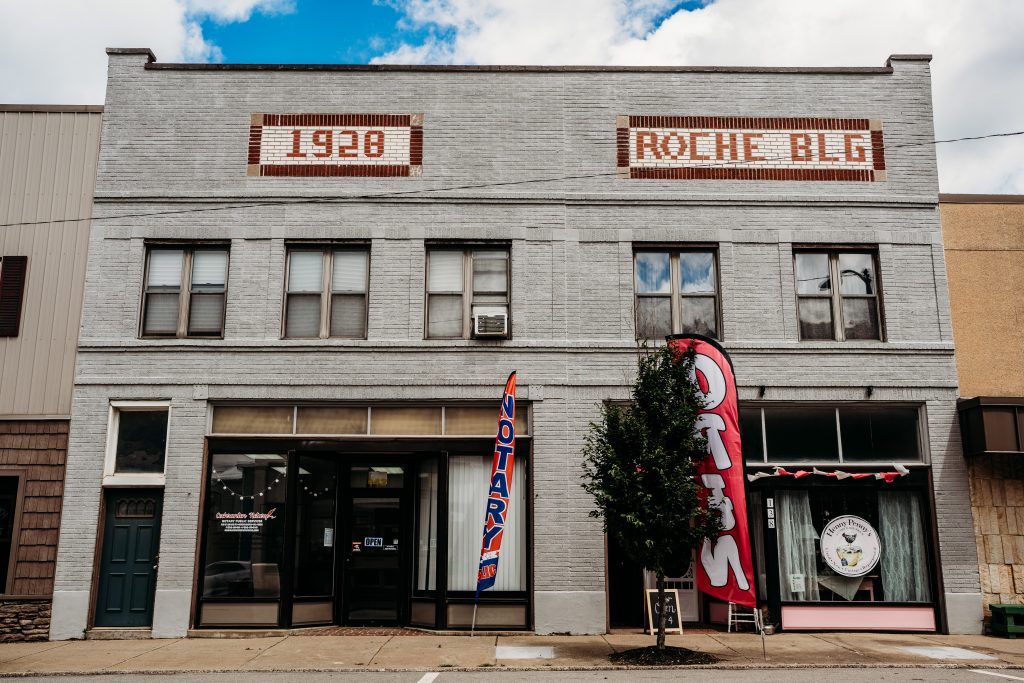
We all know one when we see one, but a small town is surprisingly difficult to categorize. Mapes spends her first chapter nailing down a pretty effective working definition. Small towns are places that are urban (1000 people per sq mi), small but not too small (2,500-49,000 people), and can provide all of the services needed for daily life (bank, library, school, etc.). A small town, like Goldilocks’ porridge, is denser and more connected than sprawl, smaller than a city, and more self-contained than a suburb. By this definition she finds 3030 small towns. She then divides these into types: from college towns to declining rustbelt towns to growing exurbs gentrifying to serve the remote-working professional class. To give some life to these statistics, she visited seven case-study towns (in the mountain west) to show the ways that taxonomy and national mythology look from city hall.
Small Towns and Rural America in Parallel
The thread connecting these chapters is Mapes’ conviction that we will better understand “rural and small-town” America if we disentangle the two. If Mapes is right about this, then why should people committed to the social, economic, and spiritual health of rural America care about small towns? Put more directly, why should you care about small towns? To be honest, it doesn’t seem to be a question that Mapes has considered. Reading between the lines, she seems to want to distance the small towns she loves from rural America. That may be healthy in some cases. I have my doubts.
As someone who has spent a lot of time living in small towns and studying rural history, however, I finished the book with a renewed sense of the potential, and, perhaps, unavoidable interdependence between town and countryside.
For starters, both rural and small town America are caught up in the same stories of nostalgia and decline. Both grew up in a nineteenth-century America defined by rail and have been reshaped by the twentieth-century America of the automobile and, more recently, the internet. Both have been fundamentally transformed by economic shifts in agriculture, manufacturing, and retail. Both have been caught up in the modern politicization and nationalization of every problem of daily life. And, finally, both have struggled to provide jobs, housing, and opportunities to their best and brightest in a metropolitan, globalized economy.

Small Towns and Rural America in Partnership?
So much for the parallels. What room is there for partnership? Mapes has a lot to say about the ways that towns have more recently attracted urban and suburban migrants seeking a haven from the hustle of the city. Tourism and amenity migrants have funded revitalization in many towns, especially in the West, where grand vistas, hiking trails, and dude ranches attract residents. The result, though, puts these towns in a bind. They constantly have to maintain a fragile balance between the promise of economic growth and preserving their particular “character.” As she points out, “media and academia [both] work under the premise that a growing city is a successful city.” (85) But a booming small town, a town that becomes popular to outsiders, is always in danger of drowning in outside money, outside residents, and outside values. Even more troubling, this type of development tends to benefit local landowners and business owners more than longtime residents and local communities.
What if there were another way? The history of small towns shows that they were the healthiest when they provided a cultural and economic hub for the countryside. Rural customers have, historically, been the lifeblood of the small town. Towns, in turn, offered rural Americans greater opportunity for education, social life, and employment. At their best, each small town offered their corner of rural America the benefits of urban life at a scale that kept town leaders attentive to the needs of rural Americans. That is, admittedly, an ideal. Things were always more antagonistic in practice, but they were not as antagonistic as they often seem now.
As Mapes points out in her conclusion, “small towns as pockets of population density in the countryside owe their existence to [their role as] . . . central places, settlements that arose where services were provided for those living in surrounding rural areas. Today, the ability of a small town to sustain itself without outside contributions is less clear.” (125) The small towns that endure will be ones that are able to develop local and regional economies, whether around small-scale agriculture, specialized manufacturing, tourism, or cultural festivals, that restore small towns as hubs of rural life and that will better connect the two while preserving the distinctions of each (128).
Restoring small towns as centers of rural life also offers a pathway for both townies and rural people to practice the habits of civic life in a shared community. As Mapes concludes, “small towns offer above all opportunity for change” (130). They are small enough for citizens to take the reins and do the work of building consensus for small wins and incremental change across the political and social divides that seem so vast at the national level.
Small-Town Churches?
That, at least, is my hopeful reading of the book. But what does all of this mean for the church? Mapes never mentions it in roughly 130 pages of text. There is a lot that could be said about this. A generous reading would suggest that her focus on seven tourist towns in the West, one of the least churched areas of the country, skews her focus. Perhaps. It is probably fair to presume that Mapes does not see the church having a role to play in the social, cultural, or economic life of small towns. I suppose one could blame this on the secularization of higher education or some other such thing. I expect, though, that at least some of the blame rests with rural and small-town churches. These churches have, like small-town shops, struggled to continue to attract people in an era defined by big-box churches as much as by big-box retail. Many of them, however, have also allowed national politics and cultural battles to turn their attention from the poverty, brokenness, and blight on main street or in the trailer park behind Dollar General.
So where should the church fit in? It seems obvious that churches in general, and pastors in particular, have a real opportunity to work toward the revitalization of their small towns—towards shalom, a far richer and ultimately more important goal than sustainability. As prominent institutions, social hubs, and, often, as owners of downtown real estate, small-town churches are uniquely positioned to “seek the welfare of the city” (Jeremiah 29) where they worship.
Small-town and rural churches can also, through their denominational connections and pastoral networks, play a role in stitching town and countryside back together. Each is called to preach the gospel and live as a humble outpost of the kingdom where they are. For many that means digging in and taking up the hard work of loving both the places and the people of American small towns and the rural areas that surround them.

Dr. Andrew C. Baker is an associate professor at Grove City College where he teaches US History. After growing up in the Washington DC suburbs, he spent time in western Pennsylvania and the Shenandoah Valley before receiving his PhD from Rice University. His scholarly work looks at the relationship between American cities, suburbs, and the countryside. He recently co-edited a special issue of the journal Agricultural History on place-based history writing and is working on a book on the histories and legacies of cotton agriculture in the US South. As a small-town resident in rural Northeast Texas for a decade, Dr. Baker has been involved in efforts to revitalize public spaces including parks, a library, and a historic downtown. He enjoys finding ways to promote revitalization while preserving the best of local history and natural beauty. He currently lives in Grove City, Pennsylvania, with his wife and three children.

