
Rural and Small-Town America: Context, Composition, and Complexities, by Tim Slack and Shannon M. Monnat, Oakland, CA: University of California Press, 2024, 232 pp., $29.95 (paperback).
How do you define rurality?
Over the last decade, I’ve been in a lot of conversation in which this question has come up. The reality is that the definition and experience of rurality can vary widely for folks from different places and perspectives. Often we discuss rurality from the vantage point of our own self-perception or the self-perception of folks in our towns and villages. At other times, I’ve heard folks designate rural based on federal guidelines (more on that in a minute). More often than not, it seems like most folks (rural and urban, alike) take an informal, but nonetheless personally definitive “know-it-when-I-see-it” posture on what constitutes rural.
The Upside of Holding Multiple Definitions of Rurality
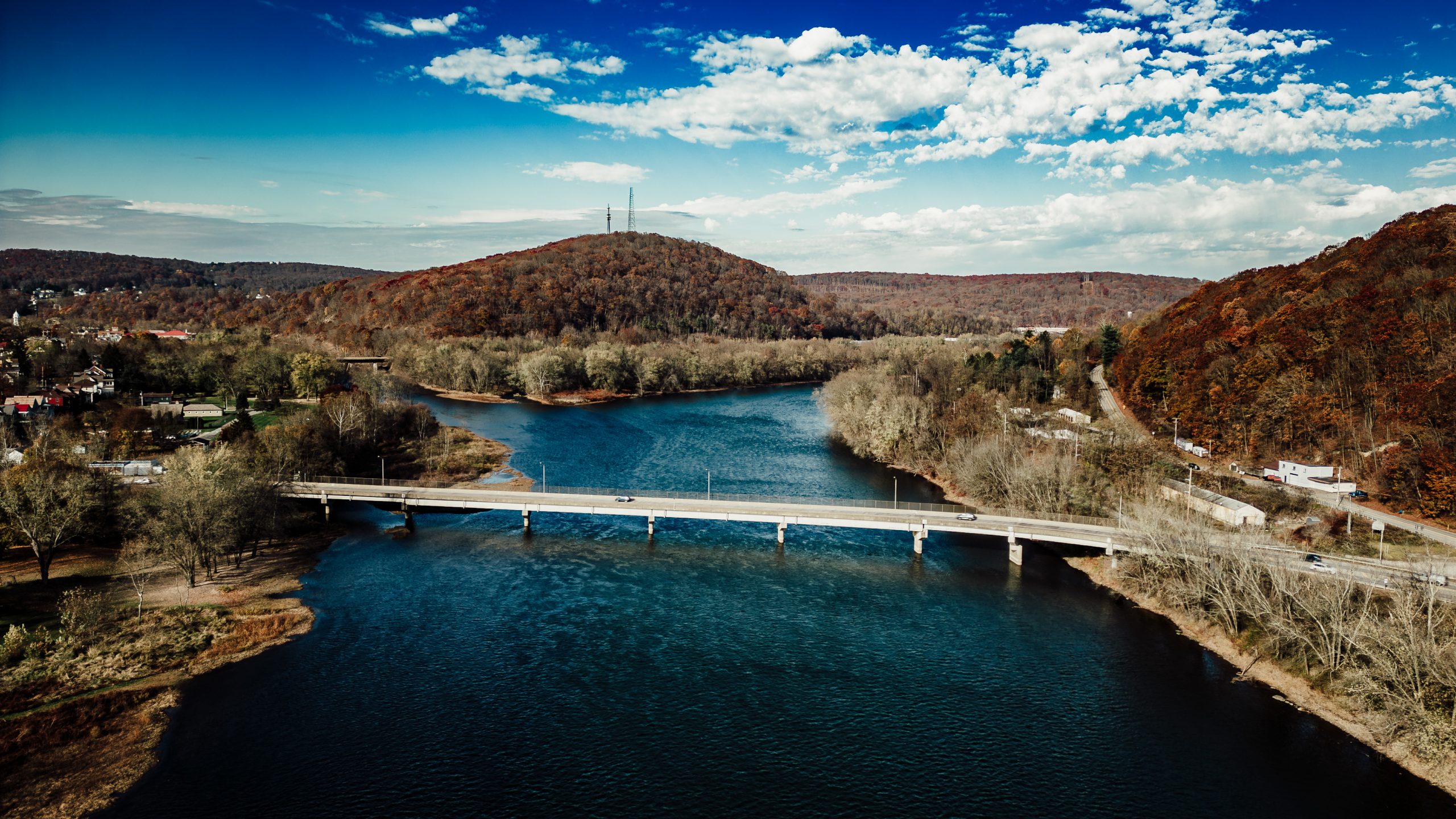
In our current cultural moment, there is a blessing in this multitude of definitions. Since at least the 2016 presidential election, there has been a greater awareness of a so-called urban-rural divide in the United States. In recent years, Christian organizations from seminaries and colleges to publishing houses and parachurch ministries have launched projects intended to identify challenges and opportunities in rural churches and communities. Our work at Grove City College’s Center for Rural Ministry, which we launched in 2019, is one of these projects.
The attention given to rural areas is not limited to explicitly religious organizations. In the last two years, one large philanthropic organization (Lilly Endowment, Inc.) has invested nearly 100 million dollars in a new initiative directly tied to supporting rural ministry and even major D.C. think tanks like Brookings Institution and American Enterprise Institute (AEI) have launched a joint commission on rural prosperity. With all this work underway, it matters how we define rurality. If rurality can be defined broadly, more places can be blessed by the work of these projects. Smallish places everywhere may get a piece of the pie.
Paying Attention to Rural and Small-Town America
Even with this recent surge of attention, there’s still more happening on the ground in rural America than media outlets and national commentators know. As welcome as this recent attention is, the fact that people are paying attention to rural places (and the pastors and congregations that faithfully serve them) is not what makes these places significant. Rural places are significant in their own right because they are places God intentionally chose to create and they are filled (just maybe not filled quite as densely) with people who bear the image of their Maker. Of course, rural matters. We can shout it from the roof tops. No amount of national attention or inattention will change it. Rural places already have God’s attention.
So the question facing those of us who care about rural America is not whether rural matters but how to find common ground in our ministries as we work with other ministries and organizations to serve rural places. Of course our efforts will be contextualized to our specific corner of rural America, but we still need to know how to define rural and how differing definitions of rural can shape everything from political policy to our own ministry efforts.
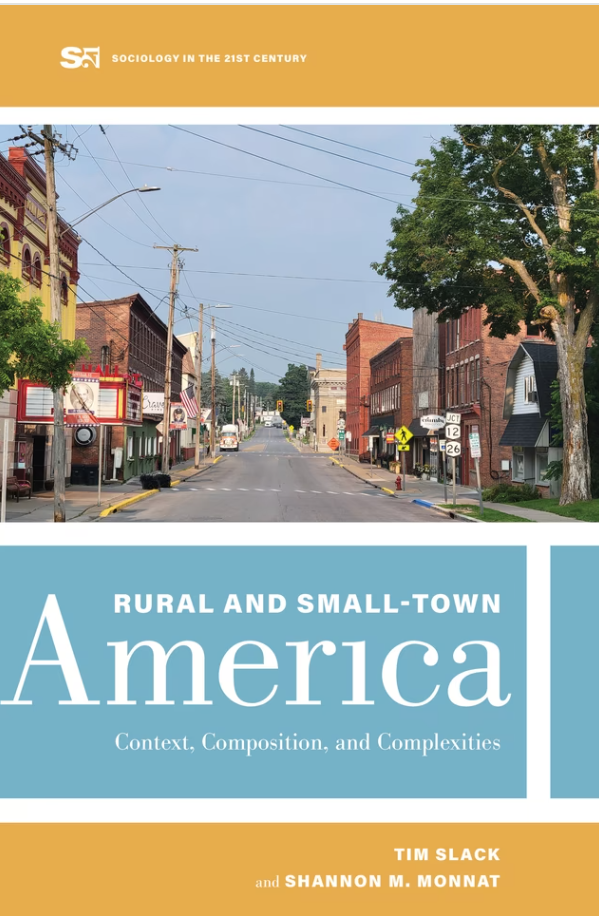
So what does the adjective “rural” mean when we use it in front of nouns like “churches” or “America?” This is the question Slack and Monnat answer in the introduction to Rural and Small-Town America: Context, Composition, and Complexities. Their layout of multiple definitions—in both their overlap and distinctiveness—is as clear and concise as I have seen. Because of this, the introduction to this book can serve as a quick reference guide for pastors, district superintendents, and other denominational leaders who work with rural pastors and congregations.
Love and Attention Go Together
If you are like me, it is easy to care about rural places without taking time to attend to either the designation of rurality used by U.S. government agencies and those who make state and federal policies that dramatically impact rural people. (Truth be told, I have always been a know-it-when-I-see-it rural person, myself.) Furthermore, we may have a sense for the promises and challenges inherent to our corner of rural America, but how do we know if other rural folks experience these same challenges and opportunities? In short, if we love rural places, it is worth getting to know rural places better.
Taking time to look at rural areas through a variety of channels—from everyday interactions to rigorous historical or sociological analysis feels a bit like being a parent who allows their child to take his or her senior pictures in a variety of places and outfits. Each new outfit and setting provides a unique glimpse of the person you have loved these 18 years by highlighting a different part of their life and personality. I think the same think can be true of how we look at rural areas. We may interact with rural areas in a wide variety of ways, and maybe a book like this feels too formal, but isn’t it good as a parent to see the formal headshot with all its maturity, too?
Love and attention always go together. That’s why it is always worth looking at the places and communities we love again. It is always worth asking ourselves what our at-the-ready definitions and intuition might have missed.
Convictions like these are what drew me to Tim Slack and Shannon M. Monnat’s clear definitions and data-driven observations of trends that shape the lives of the 46 to 66 million (depending on what metric we use) folks who call rural America home. And—what is almost as surprising as it is refreshing—Slack and Monnat carry out this effort “to paint a social demographic portrait of rural and small-town America” with very little condescension or judgementalism (6).
Defining Rural
One of the most helpful sections of the book comes near the beginning when Slack and Monnat describe three ways in which different agencies within the federal government define rurality. Here’s a concise list to help us all keep these approaches straight.
1) U.S. Census Bureau (Rural vs. Urban)
The U.S. Census Bureau provides the U.S. government with the primary definition of rural vs. urban by defining urban areas as having at least 2,000 housing units or at least 5,000 people. Slack and Monnat point out that rural areas are residual—“all places not defined as urban” (9). Using this definition, there were about 66 million people (or about 1 in 5 Americans) living in rural areas in 2020 (11).
2) U.S. Office of Management and Budget (OMB)
This method of analysis is helpful because it describes places as metropolitan or non-metropolitan on a county-by-county scale. Metro counties are counties that contain at least one urban area of over 50,000 residents. Slack and Monnat point out that the OMB designated 3 in 5 U.S. counties as non-metro in 2020. Interestingly, it is this measurement that provides the low number of rural residents. While the majority of U.S. counties are non-metro by this measurement, these counties are only home to 46 million people, or 14% of the U.S. population (13).
3) USDA Economic Research Service
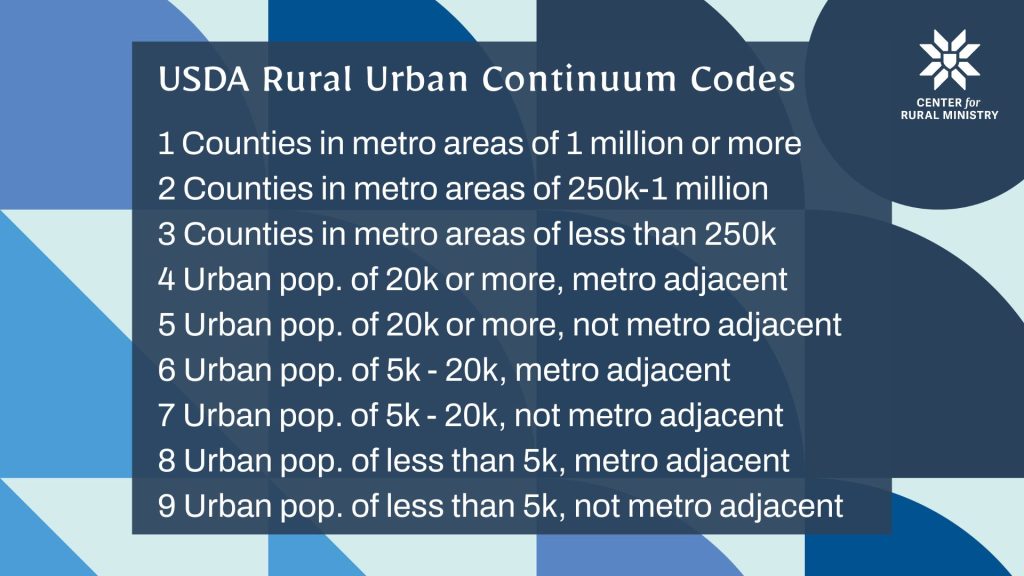
While the OMB’s county-level assessment provides a degree of granularity, most of us recognize that a simple distinction between metro and non-metro or rural vs. urban doesn’t actually address the degrees of rurality we experience in different places. In reality, we experience rurality as a continuum. We might describe two places as rural, but in terms of population density or proximity to larger metropolitan areas, one place may be far more remote than another. This is what the United States Department of Agriculture’s Rural-Urban Continuum Codes attempt to measure in the following 9 gradations:
4) National Center for Education Statistics (NCES)
While Slack and Monnat do not include this analytical tool in their introduction, it is one that we have found helpful in our work at the Center for Rural Ministry. In our experience, most small towns and rural areas contain two institutions that continue to function as community hubs. These institutions are local churches and public school districts. The National Center for Education Statistics (NCES) uses data from the latter to populate its own continuum system, which designates every school district in the U.S. along a four-part gradation from large urban districts (designated 11 on the scale) to districts that are rural remote (designated 43 on the scale).
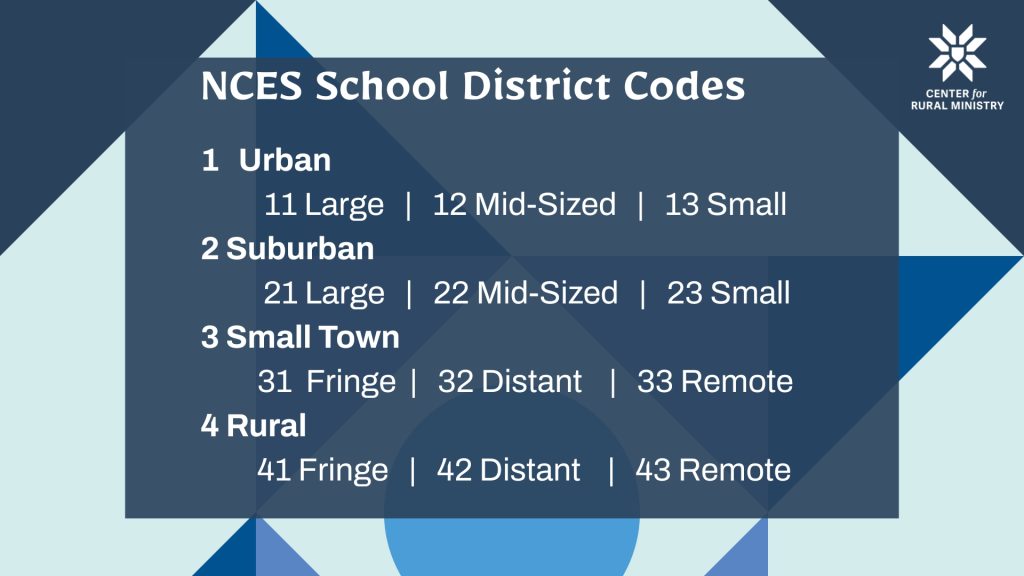
Using the NCES’s online “Locale Lookup” feature, one can enter a zip code to find the NCES designation of the school district that serves that area. In our work, we have used this method because of its ease of use and our belief that community hubs like schools and churches matter deeply in most of the rural communities we serve.
Beyond Definitions
However we define rurality, the reality is that in the end we are talking about real people and places, not simply numbers on a map. As Slack and Monnat observe near the end of their introduction, “rural areas are not a monolith” (14). Not only are rural areas different depending on their geography and population density, they are also shaped by things like demographics and dominate forms of labor, each of which can shift from one rural region to another.
It's important to understand key definitions of rurality, but definitions are not enough. People matter, places matter, and policies matter. Slack and Monnat take up these subjects and much more in the body of their book, and we’ll take them up with them in part two of this review as we move from asking “What is rural?” to asking “Who lives in rural areas?” and “What local and national trends shape their lives?”
Stay tuned.

Charles E. Cotherman is executive director of the Center for Rural Ministry and an assistant professor of Biblical and Religious Studies at Grove City College. He is also a pastor at Oil City Vineyard, a church he and his wife Aimee had the privilege of planting in 2016. He has written on rural ministry, church planting, and history for a variety of publications including Evangelicals, Modern Reformation, Front Porch Republic, and Plough. He is the author of To Think Christianly (IVP Academic) and a contributing editor of Sent to Flourish: Guide to Planting and Multiplying Churches (IVP Academic). His next book, Strip MIne Jesus: Hope for the Rural Church, Small Towns, and Overlooked Places, will be released August 2026. He lives with his wife, four children, and a spoiled cat and dog in Oil City, Pennsylvania. Charlie can be reached at charlie@ruralministry.org or on Substack.

