

The church has always had to respond to the advent of new technologies: Use a printing press? Wire the church for electricity? Amplify the priest’s sermon? Project lyrics or stick with a hymn book? Livestream the service or not? Now, artificial intelligence is everywhere. Over the past few years, it has rapidly taken on a greater role touching many spheres within society, and as with any technology the church’s response is a blend of the theological and the practical.
Christians must prayerfully consider how to engage with artificial intelligence. Does AI have a place in the church? Should we interact with it at all? To explore these questions and more, the Center for Rural Ministry sent out an informal questionnaire to pastors asking what the rural church’s view of AI looks like. Here, we review and reflect on the anonymous responses received from three pastors about their views regarding the ethics of using AI in a church setting and to what extent it should be used (if at all).

Is AI a prevalent issue in rural areas?
AI is a frequent topic of conversation in the news and the realm of higher education. It has become a tool heavily relied upon in the world of business, and a heavily disputed ethical question in creative fields. But has it reached the rural population? Are people in rural communities using AI?
The general consensus of the pastors who responded to the questionnaire seems to be that AI is still a relatively new frontier in rural areas. The people in their communities are unfamiliar with artificial intelligence, and it is used by relatively few people. This view probably translates to most people in most communities. Internet searches now promote AI responses, but it still feels basically like using Google. Fewer people are prompting ChatGPT in their daily lives.
However, as Artificial Intelligence continues to develop, the pastors expected that its sphere of influence will grow. So the church must consider how to appropriately relate to AI.
Does AI have a place in the church?
Responses regarding whether Artificial Intelligence should be used in the church varied. Some pastors do not think that AI should be used at all in the church. Others believe it could be used in ways to benefit the congregation, but it should be limited to certain roles.
One pastor who has worked in ministry for several decades cautions the church not to lose sight of the value of the relationship with God that is fostered when one takes the time to prepare a sermon. “This may be an antiquated view,” he said, “but I feel that pastoring the church and worship is a spiritual reality of communion between the Holy Spirit and the human participants. Furthermore, I feel that God is glorified in using human frailty as one of his primary means of communicating His love and His leadership.”
Another younger pastor believes that AI could be useful for the church, but only when used in certain roles such as coming up with catchy sermon titles, generating ideas or creating church announcements. This pastor also thinks it could be helpful when employed for a church’s marketing efforts by creating social media captions.
This pastor concluded, “Ultimately, I just think humans should use AI as a tool to further human reasoning and thinking as opposed to delegating our brains, which God created, to AI.”
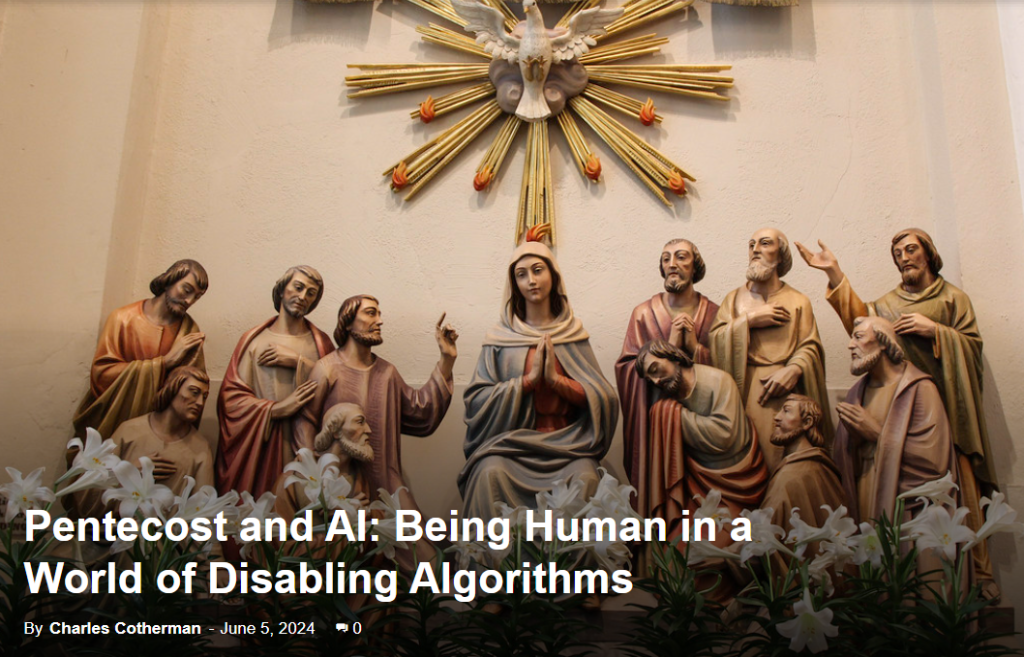
from CRM executive director Charlie Cotherman.
Should AI play a role in sermon preparation?
Taking it a step further, the CRM questionnaire asked pastors whether they had ever used AI for the purpose of planning a sermon. Results varied. One pastor had used AI to for research when developing sermon material: “I have tried it as a research tool. I have gotten ideas for fleshing out some outline thoughts for a Sunday School lesson and a few sermons.”
This pastor had also used AI as a resource for other areas within the service: “The way that I have enjoyed using AI for worship prep is getting help writing prayers. I have used significant portions of prayers that AI has suggested. I script all my prayers. Over the years I have collected hundreds, even a few thousand prayers. AI has helped me keep prayers fresh.”
While this pastor has explored AI’s potential within the church, he also makes sure to evaluate the content produced before deciding to incorporate it into his sermon materials: “I find it to be a mixed bag. Sometimes I appreciate the result, sometimes I would rather consult my books or just not use content it has suggested.”
Other pastors are not comfortable using AI as a tool when developing material for preaching. One pastor said, “Perhaps this is ignorance, but I don’t trust AI to produce content or ideas for sermons. I think that comes more from my personal views than my theological perspective as a pastor. I don’t know if I have a clear rationale for this distrust. I put in a lot of effort to study the Scriptures during seminary and over the course of my faith journey. AI hasn’t gone to seminary and doesn’t have a soul or an explicitly Christian worldview. Therefore, I hesitate to delegate something important, like preaching, to AI.”
Another pastor shared a similar sentiment: “Although this is in part an intellectual pursuit, it remains a Spirit fostered reality. AI to my thinking is simply applied intellect. It can be helpful in streamlining research, but there again, as the computer has replaced the card catalog, one no longer enjoys the randomness of stumbling across an item or idea from a card 16 in front of the one that is sought.”
“Anyone who is a student of history recognizes that each step forward in human progress and technology simply provides a brand-new double-edged sword. AI must be included in this. It could be a wonderful servant but a lousy master. As for this curmudgeon, outside of how AI is used to speed up computer results, I will not be leaning on it to make our worship and my sermon writing more efficient.”
The pressure of efficiency is a consideration in this issue. As CRM executive director Charlie Cotherman recently shared, there are theological reasons not to spend too much time on a sermon if it takes away from a pastor’s presence in the community and with people. I (Adam) recently had a conversation with a leader of a parachurch ministry for rural pastors who shared that, for pastors he works with, sermon preparation can be an excuse to stay in one’s study most of the week without engaging in home visits or being present in local public hangouts where interaction with people who are not churchgoers may happen. I also recently talked to a pastor who mentioned that he has adopted some AI tools, again not for exegesis, as a way of improving his overall efficiency with the purpose of spending more time out of the office. Pastoring is more than preaching.
At the same time, and as some of the pastors pointed out, the process of struggle and discovery that happens when wrestling with the mind, the Word, and the Spirit cannot be shortcut. Any writer will affirm that the first idea is not always the best. The science fiction writer Ted Chiang recently argued that AI will never write truly great stories. It is programmed to select the next most logical word for a sentence, not the next most meaningful or impactful. He argues that having an idea for a story (or sermon) and then giving that as a prompt to an AI isn’t writing; writing happens in the thousands of choices between the development of an idea and the last revision of the last sentence. As pastors who responded to our questions noted, praying over sermon preparation is an invitation for the Spirit to lead the creation of the sermon. Of course, the Spirit could affect the output of an AI, but He has been guiding the minds of pastors for 2,000 years.
So what do we do with it?
All throughout time Christians have been faced with shifts in cultural ideas, and they’ve had to determine if these ideas align with God’s vision for man. AI is a modern example of why Christ’s followers must be continually praying for discernment and pursuing the wisdom of the Scripture when it comes to seeking God’s will and living in accordance with it. Individuals will come to different conclusions with regard to how they should interact with culture as it develops and changes. That’s why it’s important not to be passive and instead actively learn about the culture around us while considering it faithfully as Christians walking with God both as individuals and as the collective church.

Emily Fox is a junior at Grove City College and a CRM Student Fellow. She grew up in Beaver Falls, Pennsylvania and is studying English with minors in Writing and Digital Marketing at the college. Post-grad, she hopes to pursue a career in Public Relations.

Born and raised in Topeka, KS, Adam moved east for college and never left. He is assistant director of the Center for Rural Ministry and an associate professor of English and writing at Grove City College. Adam has published several articles in education journals that focus on the use of language in educational settings. He is currently engaged in several research projects designed to help us better understand rural congregations and the communities they serve.

